One UTC Day, Three Local Calendars: What an SSOD Date Means
In New York, the observations labelled 1 January 2025 in NOAA’s SSOD dataset span from 7 p.m. on New Year’s Eve to 7 p.m. on New Year’s Day. In Tokyo, the same interval runs from 9 a.m. on 1 January to 9 a.m. on 2 January.
The dates differ because the Synoptic Summary of the Day version 2 (SSODv2) groups observations by UTC, the common time reference used in these records. Its day begins at 00:00 UTC and ends as the next UTC day begins. NOAA describes the included reporting hours as 00 through 23 UTC.
That gives stations the same 24-hour frame. It also means that a value labelled “1 January” may include observations from the previous or following local date. Check that boundary before comparing it with a local weather report.
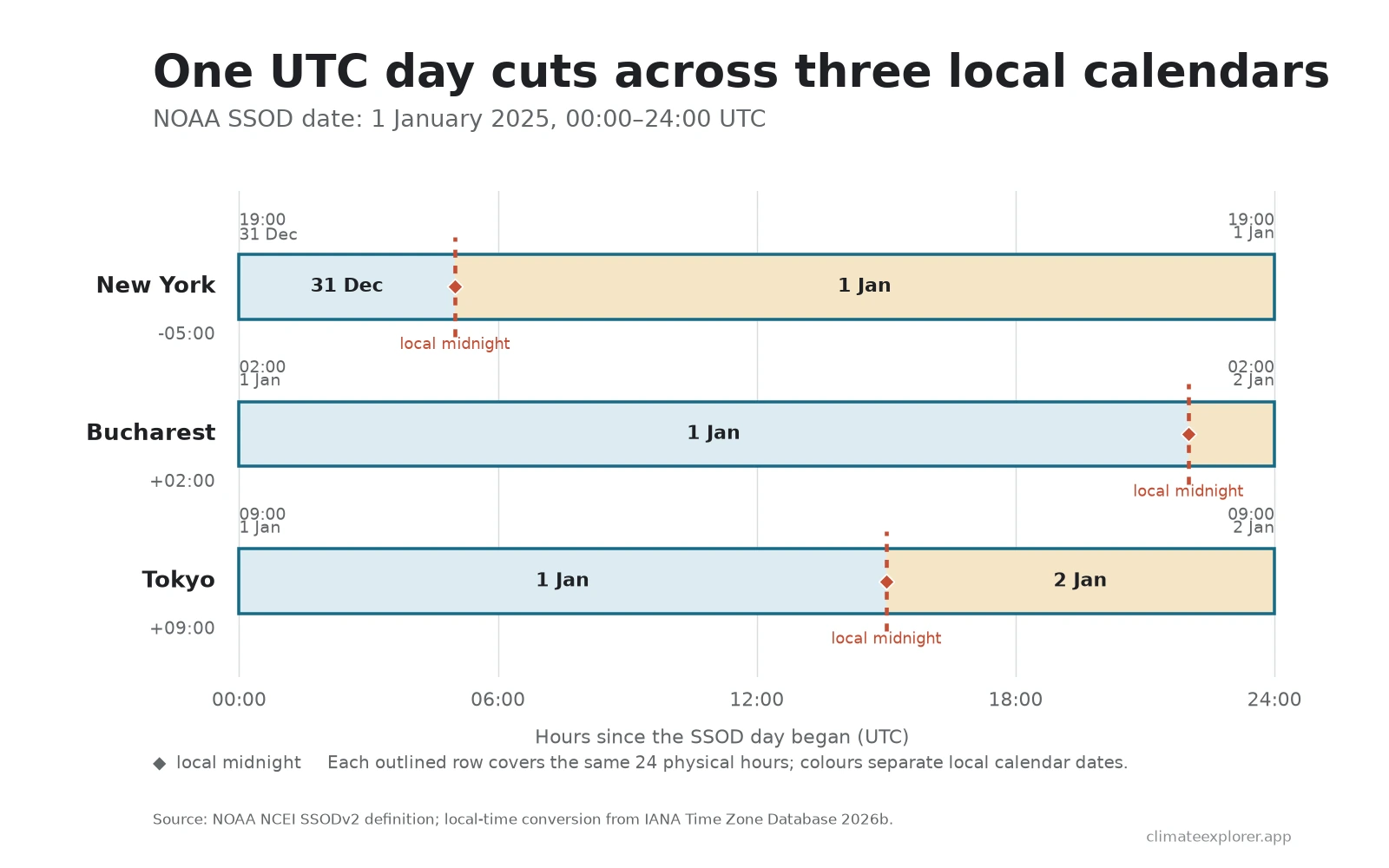
One interval cuts across local calendars differently
The timeline shows the same 24 hours on three local clocks. New York starts during the evening of 31 December. Bucharest starts at 02:00 on 1 January and finishes at 02:00 on 2 January. Tokyo finishes later that morning. The endpoint marks the start of the next UTC day and is not counted twice.
This does not mean that any row is longer, or that SSOD combines two complete local days. Every row spans the same 24 hours. It means that a value carrying the SSOD label “1 January” can include observations that a local clock assigns to the previous or following date.
The offsets in the example are date-specific. Time-zone rules and daylight-saving time can change the mapping on other dates. Bucharest is used only as a civil-time illustration; the figure makes no claim about observations from a Bucharest weather station.
Why use UTC at all?
Weather services exchange synoptic observations—reports of conditions at agreed times—using UTC. SSOD builds its daily summaries from hourly and synoptic reports in NOAA’s Global Historical Climatology Network hourly dataset (GHCNh), nominally grouping them into the same 00–23 UTC interval.
NOAA identifies a practical benefit: the common time frame can make SSOD easier to align with numerical weather-prediction output and remotely sensed data.
Sharing a clock solves one comparison problem. Station setting, the variable being measured and gaps in reporting still matter.
“Daily” does not guarantee a complete local extreme
The fixed UTC frame describes when observations are grouped. It does not guarantee that every meteorological field is complete. NOAA warns that SSOD precipitation totals may be underreported and that its maximum and minimum temperatures may not capture the true daily extremes.
This distinction matters when the question is tied to a local date. For the most accurate daily rainfall or temperature extrema, NOAA recommends consulting the appropriate national-service daily summaries in GHCN-Daily. Those products may follow national observation times and conventions rather than one worldwide midnight boundary.
Even a precipitation value of zero needs its accompanying measurement code: it is not automatically proof of a complete, dry local day. An asterisk on a maximum or minimum means NOAA derived it from the hourly reports rather than the dedicated climate group in a synoptic message. It tells you where the value came from, not that the true extreme was captured.
Match the definition of “day” to the question
SSOD is a sensible starting point when the question requires one synchronized interval—for example, when aligning station summaries with globally timed model or satellite products.
An official local product is usually the better reference when the claim concerns a calendar-date record, a locally defined heatwave, or an exact daily precipitation total. The boundary must still be checked: national daily products do not all run from local midnight to local midnight.
The practical rule is simple: before comparing daily values, ask what hours the date actually contains. Two products can both be scientifically useful while answering different questions about “the same” day.
Explore and verify the distinction
Climate Explorer’s SSOD Explorer is an independent interface that retrieves, parses and presents SSODv2 records published by NOAA/NCEI. Climate Explorer is not affiliated with NOAA, and NOAA remains the authoritative source for the data and field definitions. For a reproducible example, open the Central Park SSOD table for NOAA station USW00094728, or the Tokyo SSOD table for station JAI0000RJTD. Both use the SSOD UTC date; the local-clock conversion shown in this article is an additional explanatory calculation and is not displayed by the Explorer. The SSOD guide explains the interface, exports and screening checks in more detail.
For upstream verification, use NOAA’s Central Park 2025 SSOD file, Tokyo 2025 SSOD file, and SSODv2 documentation. NOAA remains the authoritative source for the dataset and its field definitions.
Conclusion
An SSOD date identifies a shared UTC interval. In the January example, that interval includes New Year’s Eve in New York and part of 2 January in Tokyo. Before treating two daily values as directly comparable, check which hours each includes and whether the observations are complete enough for the question.
Editor note: This explainer uses NOAA SSODv2 documentation version 2.0.0 and IANA Time Zone Database release 2026b. On 11 September 2026, we rechecked the documentation and time conversions and rewrote the opening around the local-clock example. The timeline values are unchanged; no weather measurements are analyzed.
Frequently Asked Questions
Does an SSOD date mean midnight to midnight in local time?
No. SSOD uses the UTC calendar day, nominally 00–23 UTC. The same interval can begin on the previous local date or end on the following local date, depending on the station’s time zone and the date being examined.
Is UTC the fairest way to compare daily climate data worldwide?
Not in every case. UTC supplies a synchronized interval and can ease alignment with model or satellite products, but local-day definitions, sampling, station setting and field completeness still affect interpretation. Suitability depends on the question.
Should SSOD be used to verify an official daily record?
SSOD provides a synchronized daily summary, but NOAA cautions that its reported extrema may not capture the true daily maximum or minimum. Verify an official local-date record with the responsible national meteorological service or the appropriate national-service daily product and confirm that product’s observation window.
Data Annex
The article’s calculation converts one fixed UTC interval into three civil-time zones. It uses no station temperature, precipitation, record or climatological baseline.
| Dataset or input | Version or period | Role in the article |
|---|---|---|
| NOAA NCEI SSODv2 | Documentation version 2.0.0, accessed 5 August 2026 | Defines the synchronized 00–23 UTC summary day, documented utility and field limitations |
| IANA Time Zone Database | Release 2026b | Supplies the civil-time rules used for the fixed conversion |
| Chart-ready timeline | 1 January 2025 UTC | Maps one 24-hour UTC interval into three named civil-time zones; no weather values are analyzed |
Inputs used for the explainer and primary visual.
| Civil-time example | IANA zone | Local start | Local exclusive end | Local midnight after UTC start |
|---|---|---|---|---|
| New York | America/New_York |
19:00, 31 Dec 2024 (UTC−05:00) | 19:00, 1 Jan 2025 (UTC−05:00) | 5 hours |
| Bucharest | Europe/Bucharest |
02:00, 1 Jan 2025 (UTC+02:00) | 02:00, 2 Jan 2025 (UTC+02:00) | 22 hours |
| Tokyo | Asia/Tokyo |
09:00, 1 Jan 2025 (UTC+09:00) | 09:00, 2 Jan 2025 (UTC+09:00) | 15 hours |
The interval is 2025-01-01T00:00:00Z through the exclusive endpoint 2025-01-02T00:00:00Z. The selected date has no clock transition in any of the three zones, and every row covers 24 physical hours.
Data Sources
- NOAA NCEI SSOD product overview: UTC-day definition, comparison with national daily products and limitations.
- NOAA NCEI SSODv2 documentation, version 2.0.0
- IANA Time Zone Database release 2026b
- WMO explanation of standard synoptic observation times