Storm Adam in Spain: 617 mm in 24 Hours at Pego
AEMET’s hourly observations show how rainfall built up at two gauges during the 18–19 October 2026 floods, with nearly half of Pego’s 24-hour total arriving in three hours.
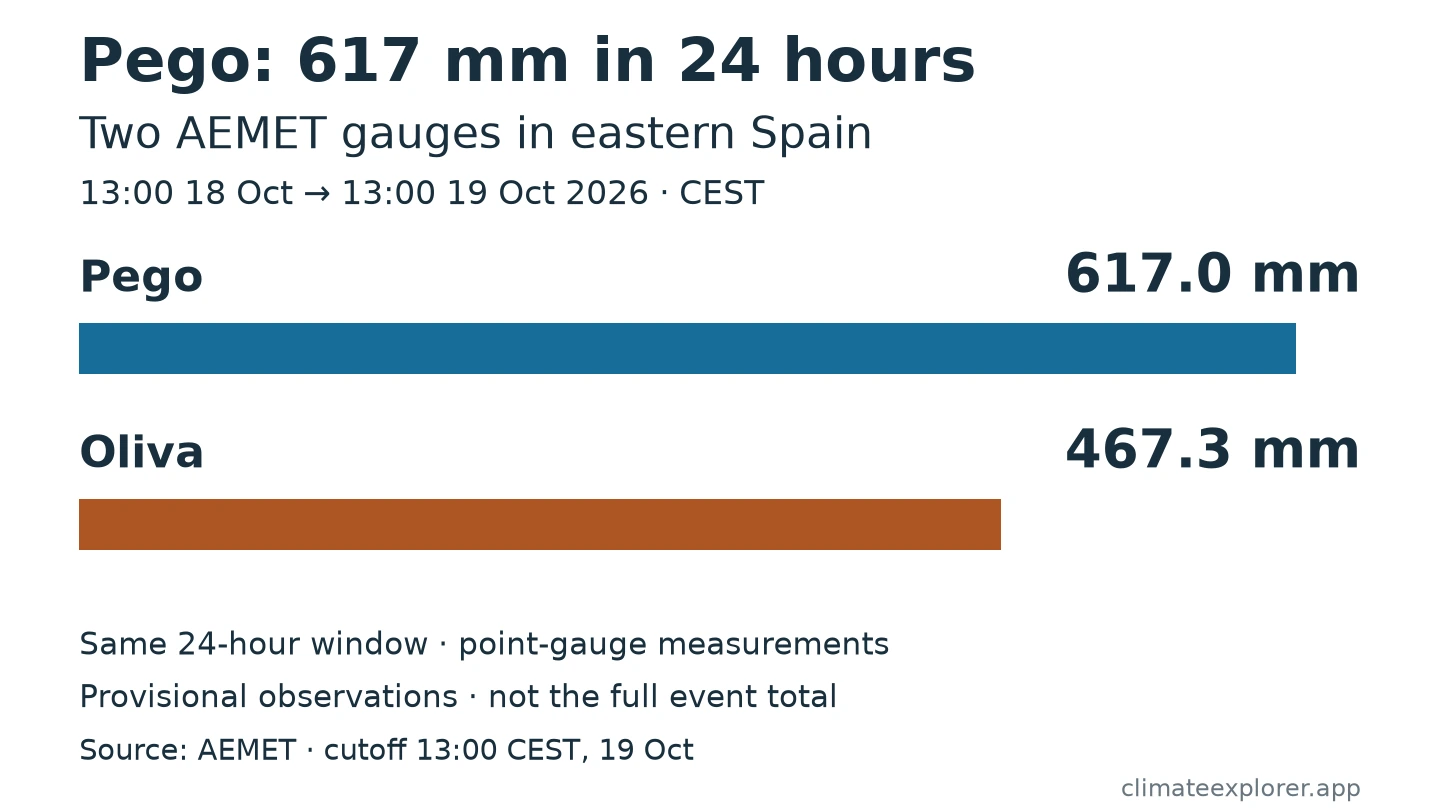
At Pego in northern Alicante, a rain gauge reported 617.0 mm in the 24 hours ending at 13:00 Spanish local time on 19 October 2026. At Oliva, in neighbouring Valencia province, the total over the same hours was 467.3 mm. These are provisional station observations, summed from AEMET’s hourly reports. They cover one selected day-long window within the storm, rather than the whole event.
One millimetre of rain equals one litre of water per square metre.
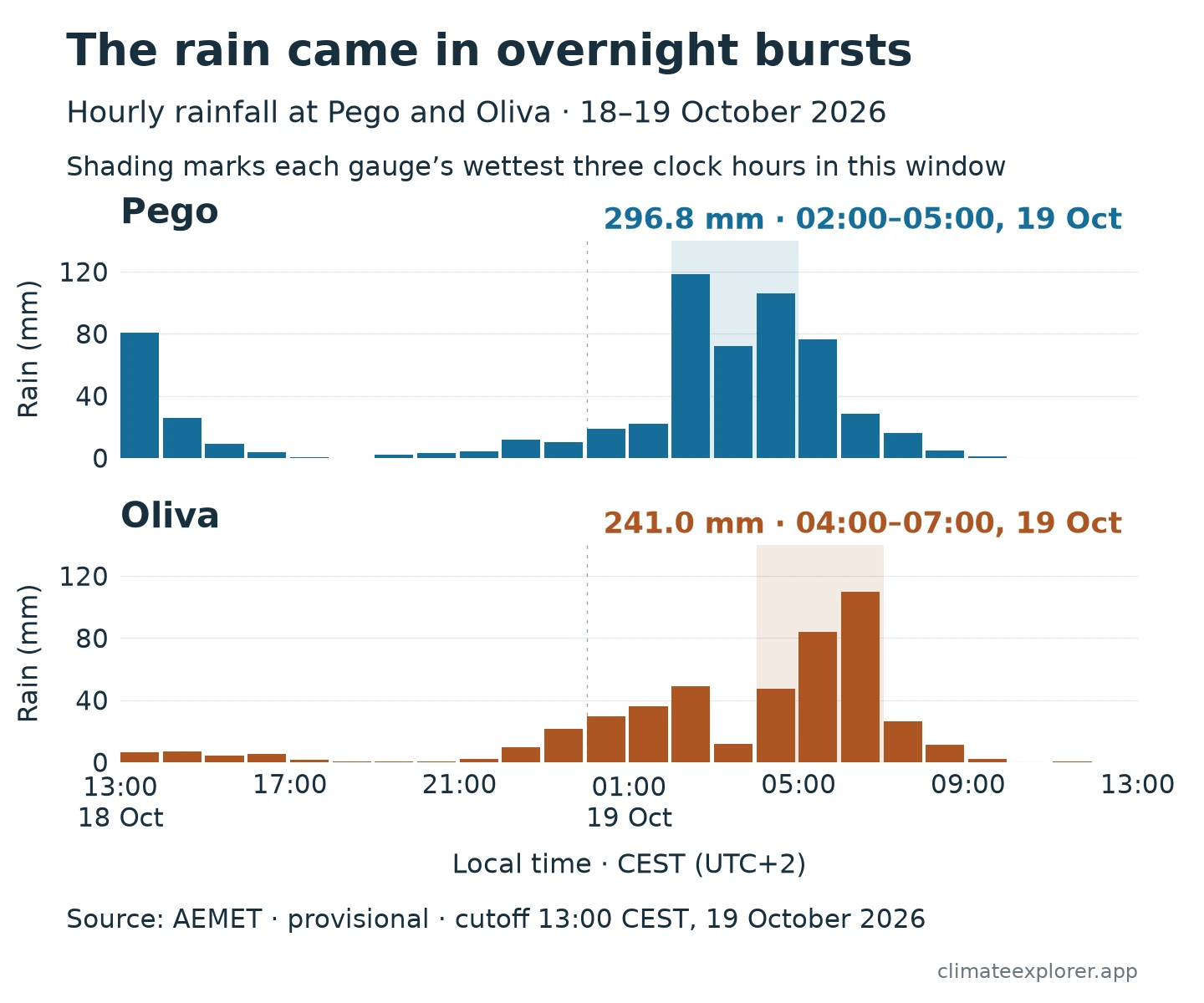
The hourly measurements reveal something the totals alone cannot: much of the rain arrived in concentrated bursts. Pego received nearly half of its selected-window total between 02:00 and 05:00 on 19 October. RTVE reported that rescue teams were evacuating people trapped by flooding in Oliva that day.
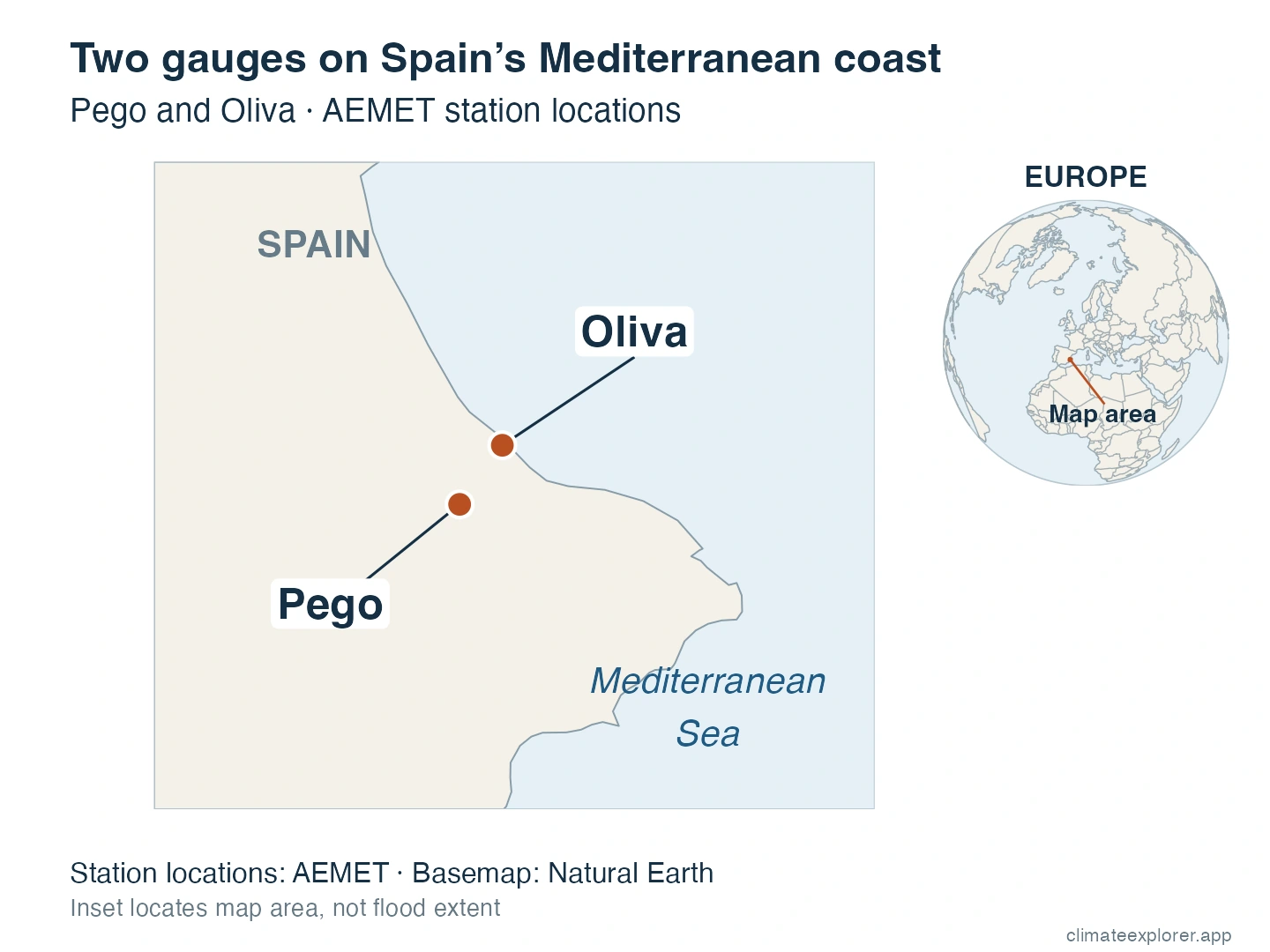
Where the two gauges are
Nearly half of Pego’s rain fell in three hours
Pego recorded 296.8 mm between 02:00 and 05:00 CEST on 19 October. The three hourly amounts were 118.6, 72.2 and 106.0 mm. Together, they account for about 48% of the station’s 24-hour total. All times in the narrative are Spanish mainland local time, CEST (UTC+2).
The first of those hours, 02:00–03:00, had the largest hourly amount in Pego’s captured series: 118.6 mm. This describes the highest of the 24 hourly reports examined, without establishing a historical record or the maximum for the whole storm.
Rain had also been substantial earlier. The Pego report for 13:00–14:00 on 18 October was 80.8 mm, so the overnight burst was part of a longer sequence.
Oliva’s heaviest reported hour came later
At Oliva, the largest hourly amount in the same captured window was 109.7 mm between 06:00 and 07:00 on 19 October. Its three consecutive hours from 04:00 to 07:00 supplied 241.0 mm. The two gauges therefore show different timing as well as different totals.
These are measurements at two particular locations. They do not establish the highest rainfall anywhere in Spain or show the depth of floodwater in either town. Nor can the difference between the gauges establish how an individual rain cell moved; that requires spatial observations and further analysis.
Adam combined an upper-level low with moist Mediterranean winds
In its special warning issued on 18 October, AEMET described Adam together with a very moist flow from the east and northeast over the Mediterranean mainland coast and the Balearic Islands. It identified a risk of local flooding and rapid rises in streams and normally dry channels, particularly where earlier rain had saturated soils.
The agency expected especially heavy precipitation around southern Valencia and Cabo de la Nao, with the risk continuing into the first half of 19 October. That was a forecast of the evolving hazard; the gauge measurements above are observations of what fell at Pego and Oliva.
How to check the rainfall
Open AEMET’s observation pages for Pego, station 8057C, and Oliva, station 8058X, and select hourly precipitation. The hourly amount belongs to the hour ending at the displayed time. For example, Pego’s 03:00 report covers 02:00–03:00 CEST.
The comparison sums 24 non-overlapping hourly reports at each station, from 13:00 CEST on 18 October to 13:00 CEST on 19 October—equivalently, 11:00 UTC to 11:00 UTC. Both captured series contain all 24 precipitation values. Because AEMET’s live pages advance, the downloadable table preserves the observations used here, including the start and end of every interval.
AEMET cautions that its recent observations have received real-time quality checks and may still contain errors. These totals may therefore change after verification. The comparison uses AEMET observations directly; the earlier October Spain article covers a separate rainfall episode.
Conclusion
The two AEMET gauges document large rainfall amounts over the same 24 hours, with a pronounced concentration into a few hours on 19 October. At Pego, 296.8 mm of the 617.0 mm total fell between 02:00 and 05:00; Oliva’s largest reported hour came later, from 06:00 to 07:00. These observations establish the amounts and timing at the selected gauges. A whole-event total, regional maximum or historical ranking requires a wider and more complete assessment.
Editor’s note: Data current as of 19 October 2026, 11:00 UTC (13:00 CEST). The selected 24-hour window is complete at both gauges; the wider event remains provisional. The figures may be updated if AEMET revises the included reports or the analysis window is extended.
Data Annex
The identifiers below are AEMET’s national station codes. Each row describes one gauge; other stations bearing the same town name must be treated separately.
| Station | AEMET code | Latitude | Longitude | Elevation | Network |
|---|---|---|---|---|---|
| Pego, Alicante | 8057C | 38.84667° N | 0.11833° W | 60 m | AEMET |
| Oliva, Valencia | 8058X | 38.90417° N | 0.06500° W | 1 m | AEMET |
| Station | 24-hour total, 18–19 October | Three-hour amount, 19 October | Largest hourly amount in this sample |
|---|---|---|---|
| Pego | 617.0 mm | 296.8 mm, 02:00–05:00 CEST | 118.6 mm, 02:00–03:00 CEST |
| Oliva | 467.3 mm | 241.0 mm, 04:00–07:00 CEST | 109.7 mm, 06:00–07:00 CEST |
The 24-hour interval runs from 13:00 CEST on 18 October to 13:00 CEST on 19 October. All amounts are provisional.
Downloads: hourly rainfall with UTC and local intervals, calculation summary, and station metadata.