Vienna’s September heat: a late peak, then a sharp cooldown
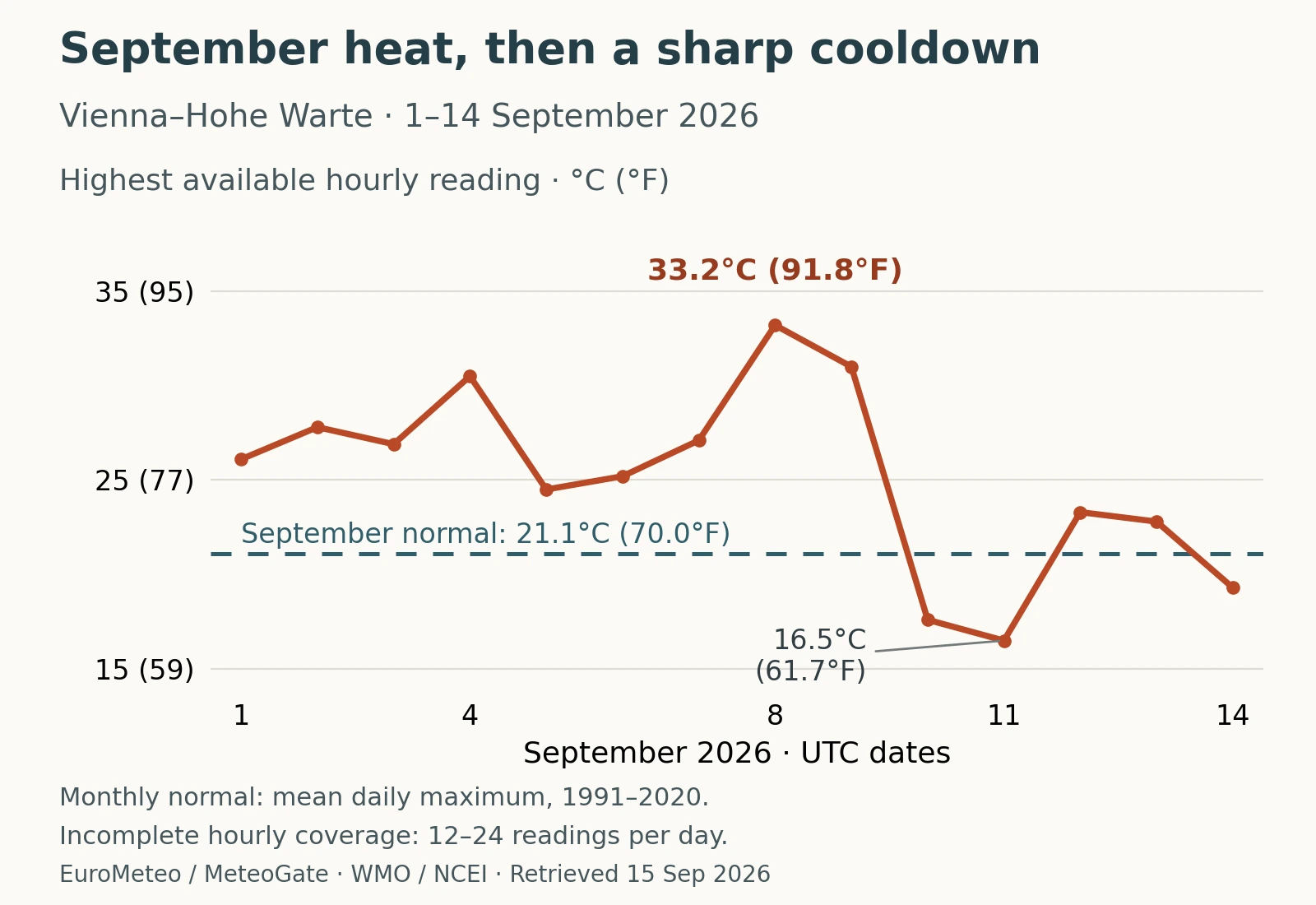
On 8 September 2026, Vienna’s Hohe Warte station reported 33.2°C (91.8°F) at 4 p.m. local time. Three days later, its highest hourly reading was 16.5°C (61.7°F). The early-September heat ended with a change that is easy to see in the station record.
The September peak was lower than August’s. But it arrived against a cooler seasonal reference: Hohe Warte’s average September daily maximum for 1991–2020 is 21.1°C (70.0°F). Matching the recent readings to the same station’s climate normal gives that late heat some perspective.
This analysis covers 1–14 September, with an early-August comparison. It uses the hourly temperatures available in EuroMeteo, with gaps retained, and checks the main findings against GeoSphere Austria’s official daily observations. It is not an assessment of the whole of September.
Four stations point to 8 September
Hohe Warte was not alone. In the four Vienna stations examined here, the highest available hourly reading fell on 8 September. Innere Stadt matched Hohe Warte at 33.2°C (91.8°F); Mariabrunn and Donaufeld reached slightly lower values.
| Station | Highest available hourly temperature | Time on 8 September (CEST) |
|---|---|---|
| Hohe Warte | 33.2°C (91.8°F) | 16:00 |
| Innere Stadt | 33.2°C (91.8°F) | 16:00 |
| Mariabrunn | 32.6°C (90.7°F) | 16:00 |
| Donaufeld | 32.7°C (90.9°F) | 17:00 |
These are four observing sites, not a temperature average for Vienna or a map of conditions on every street. Each station provides a separate point of comparison.
GeoSphere’s daily data place the peak on the same date at all four sites. At Hohe Warte and Innere Stadt, the official maximum was 33.5°C (92.3°F). That is a little higher than the hourly feed captured. A reading taken once an hour can miss the hottest moment between observations.
The September baseline changes the comparison
A climate normal describes a reference period. Here, it is the average of the daily maximum temperatures for September in 1991–2020, reported for Hohe Warte. The 21.1°C (70.0°F) value is a useful reference for a typical September daytime high at that site.
The 33.2°C (91.8°F) hourly peak stood 12.1°C (21.8°F) above that reference. This measures the distance between one hot reading and a monthly average of daily highs. It does not mean September as a whole was that much warmer than normal. Nor does a monthly average tell us how rare a temperature was on 8 September specifically.
Hohe Warte is the only one of these four stations with a matching entry in the WMO primary-parameter composite used by the Normals Explorer. The other stations help establish the timing and temperatures across the selected sites; they are not assigned Hohe Warte’s baseline.
August was hotter; September still stood well above its reference
During 1–11 August, Hohe Warte’s highest available hourly reading reached 39.5°C (103.1°F). Its August mean daily maximum normal is 26.1°C (79.0°F), giving a peak-to-normal difference of 13.4°C (24.1°F).
For September, the corresponding difference was 12.1°C (21.8°F). The two gaps are fairly close even though the August temperature was much higher. The lower September reference explains why a temperature in the low thirties deserves attention later in the season.
These comparisons do not establish equal rarity, equal duration or equal effects on people. They answer a narrower question: how far did each available hourly peak sit above its own month’s average daily high at the same station?
By 11 September, the picture had changed
At Hohe Warte, the highest hourly reading on 11 September was 16.5°C (61.7°F), with all 24 hourly temperatures present that day. GeoSphere’s official daily maximum was 16.9°C (62.4°F). Both sources show the cooldown after the 8 September peak.
That sequence is the September story: a late hot spell visible across several stations, followed by a marked fall in daytime temperatures. August supplies context, while the September observations show how quickly conditions changed.
Check the observations and the normal
Open the EuroMeteo Explorer, choose Austria, then WIEN/HOHE WARTE (11035-0), and set 1–14 September 2026. In the Dashboard, inspect air temperature and the 8 September, 14:00 UTC peak. This is 16:00 CEST in Vienna. If the embedded view does not retain the selection, open the selected station dashboard directly. Use the EuroMeteo guide for the export workflow.
For the baseline, open Hohe Warte in the WMO Normals Explorer. Read the September column of Max Temperature: 21.1°C. The dataset definition is mean daily maximum temperature, despite the shorter interface label.
Data Annex
Stations and identifiers
The WIGOS codes below identify the observation stations. Hohe Warte’s WMO normals row uses the older station number 11035, stored as 00011035. The match is supported by the name, coordinates and elevation, rather than the placeholder WIGOS field in the normals file. Matching identifiers does not establish unchanged instruments or exposure throughout the reference period.
| Station | WIGOS ID | Coordinates (°N, °E) | Elevation |
|---|---|---|---|
| Hohe Warte | 0-20000-0-11035 |
48.24861, 16.35639 | 198 m |
| Innere Stadt | 0-20000-0-11034 |
48.19833, 16.36694 | 177 m |
| Mariabrunn | 0-20000-0-11080 |
48.20694, 16.22944 | 225 m |
| Donaufeld | 0-20000-0-11090 |
48.25722, 16.43139 | 160 m |
August and September at Hohe Warte
| Observation window | Highest available hourly reading | Own month’s normal | Difference |
|---|---|---|---|
| 1–11 August | 39.5°C (103.1°F) | 26.1°C (79.0°F) | +13.4°C (+24.1°F) |
| 1–14 September | 33.2°C (91.8°F) | 21.1°C (70.0°F) | +12.1°C (+21.8°F) |
Coverage and calculation
EuroMeteo supplied 278 usable hourly temperatures for Hohe Warte, 277 for Innere Stadt, 278 for Mariabrunn and 277 for Donaufeld, out of 336 expected per station over 1–14 September. Daily coverage ranges from 12 to 24 readings. No missing value was filled in; each plotted value is the highest available hourly reading for its UTC date.
GeoSphere’s official daily maximum uses ten-minute maximum-temperature values from 18:10 UTC on the previous day to 18:00 UTC on the labelled day. The official series therefore differs in both sampling and daily boundary. It independently confirms the September peak date and subsequent cooling.
A fresh 8 September archive sample agreed with all 92 temperatures present in the four processed station series that day. The archive also contained a 23:00 reading for each station that was absent from the processed responses. A later live Hohe Warte export omitted one additional reading on 14 September; none of these differences changed the reported peak or plotted daily highs.
Download the hourly temperatures, daily values and coverage counts, matched WMO normal, and August–September comparison.
Data checked on 15 September 2026. The September observation window ends at 23:59:59 UTC on 14 September. The processed feed and official observations may be revised. Calculations and the chart will need rechecking if the underlying records change. No record ranking, monthly anomaly or attribution to climate change is calculated here.
Data Sources
- EuroMeteo’s MeteoGate archive: archived station observations; this article uses the processed EuroMeteo series and checks a published archive sample.
- GeoSphere Austria daily station data and metadata: station identities, temperature definitions and quality flags. The daily-data comparison is included in the downloadable table above.
- WMO 1991–2020 mean daily maximum normals, hosted by NOAA NCEI: the Hohe Warte August and September baselines.
- NOAA NCEI’s WMO Climate Normals documentation: reference periods, elements and composite-file coverage.
Climate Explorer is an independent visualization and analysis project, not affiliated with GeoSphere Austria, EUMETNET, WMO or NOAA.