June 2026 Peaks at 17 Capital-Area Stations
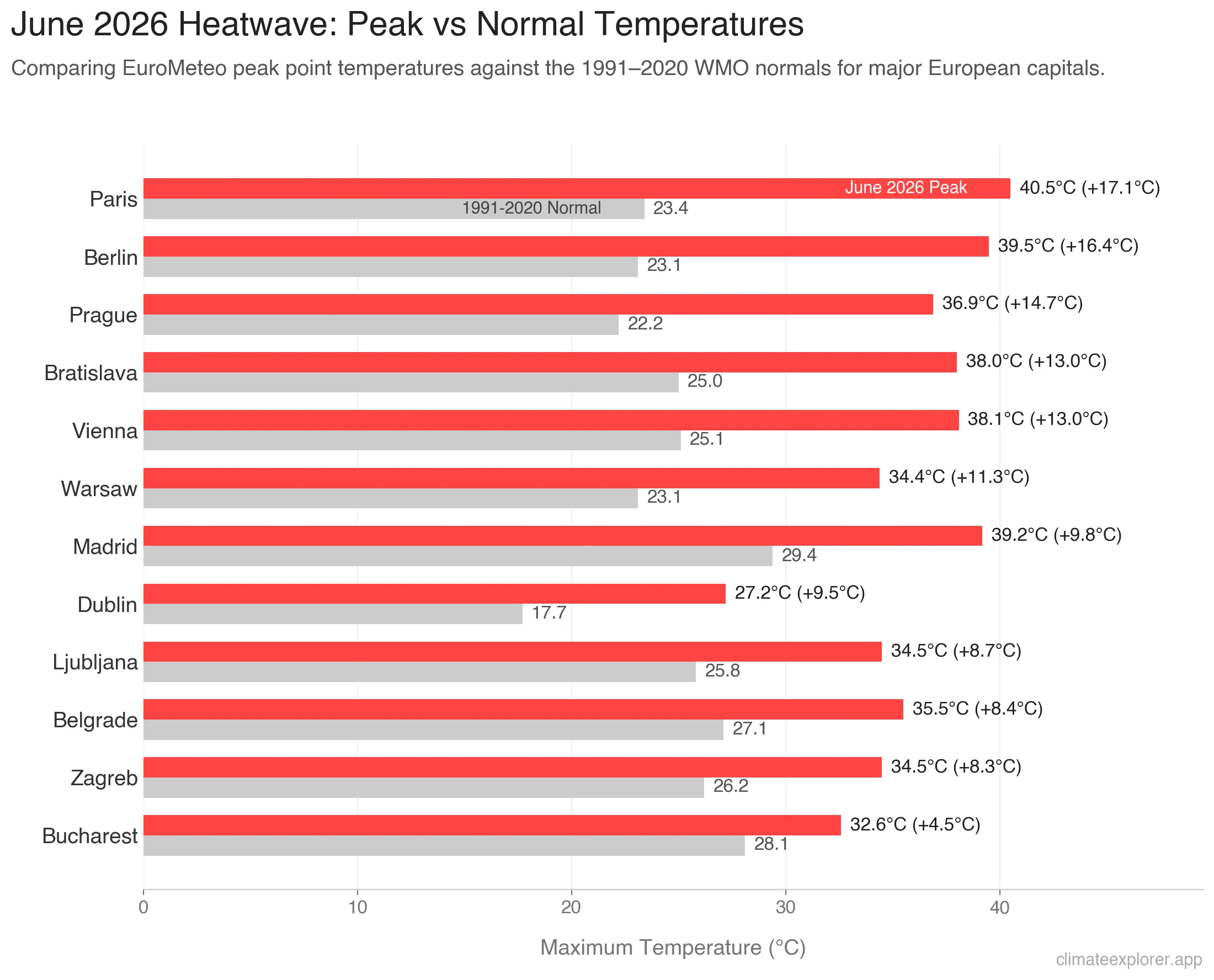
At 17 selected stations serving 12 European capital cities, the highest valid EuroMeteo point-temperature observation available through 27 June 2026 was compared with that station’s 1991–2020 WMO June mean daily maximum normal. The largest differences in this set occurred at Paris-Montsouris (+17.1°C) and Berlin-Tempelhof (+16.4°C).
Those differences are useful event context, but they are not daily temperature anomalies in the strict sense. One side of the subtraction is a single observed point in time; the other is the 30-year mean of daily maxima for June. The result does not establish statistical rarity, an official daily maximum, a station record or climate-change attribution.
Data current as of 27 June 2026. The observation series was frozen at 00:00 UTC on 28 June and does not represent the completed calendar month.
Use the EuroMeteo Explorer to inspect recent European observations and the WMO Normals Explorer to inspect the fixed station baselines. The WMO Normals guide covers station selection and CSV export; this article focuses on the evidence produced by matching the two datasets.
What the station comparison found
Six station matches were selected for the primary check because they span western, central, eastern and southern Europe and have both a valid observation-feed identity and a WMO June normal.
| Station | WMO June normal Tmax | EuroMeteo point-temperature peak | Peak-minus-normal difference |
|---|---|---|---|
| Paris-Montsouris | 23.4°C | 40.5°C | +17.1°C |
| Berlin-Tempelhof | 23.1°C | 39.5°C | +16.4°C |
| Warsaw-Okęcie | 23.1°C | 34.4°C | +11.3°C |
| Madrid-Retiro | 29.4°C | 39.2°C | +9.8°C |
| Dublin Airport | 17.7°C | 27.2°C | +9.5°C |
| Zagreb-Maksimir | 26.2°C | 34.5°C | +8.3°C |
All six peak observations occurred from 23 through 27 June. Paris and Berlin had the largest differences in the primary group, while Madrid’s hotter baseline meant a similarly high absolute observation produced a smaller difference.
This illustrates why absolute temperature and departure from a baseline answer different questions. It does not make one station’s heat more consequential than another’s; exposure, duration, nighttime temperatures, warnings and vulnerability are outside this calculation.
How the two measures differ
The WMO TMAX field used here is the mean daily maximum temperature for June over the 1991–2020 standard-normal period. It is not the highest temperature recorded during those 30 Junes.
The EuroMeteo value is the highest valid air_temperature point observation found in the selected feed through the cutoff. National meteorological services may calculate official daily Tmax from dedicated maximum thermometers, higher-frequency automatic data or quality-controlled climate products. A public hourly or sub-hourly feed can miss the hottest moment or retain a value that is later revised.
For that reason, the neutral calculation is:
highest available point air temperature − WMO June mean daily maximum normal
The article reports this as a peak-minus-normal difference, not as an official record margin.
Station identity is part of the analysis
The observation feed and normals archive use related but different identifiers. EuroMeteo stations were retained with their WIGOS IDs. WMO normals rows were selected with the corresponding five-digit legacy WMO IDs and checked against station names and coordinates.
This matters in cities with multiple stations. Berlin-Tempelhof is not interchangeable with Berlin-Dahlem or Berlin Brandenburg, and Madrid-Retiro is not Madrid-Barajas. A city-name join could silently combine two different locations and produce a plausible but invalid difference.
Paris-Montsouris required an explicit alias check: the observation feed identifier used here is 0-250-0-07156, while the normals row is identified by legacy WMO ID 07156. The comparison does not assume that every identifier containing the city name refers to the same observing site.
Seventeen stations across 12 capitals
The full matched set is in the Data Annex, with each station’s identifier and peak time. Download the 17-row comparison to reproduce the differences. Some cities contribute several stations, and others are absent; this is a selected set, not a ranking of all European capitals.
What the differences leave out
A peak-minus-normal difference does not measure rarity, event duration or conditions across an entire city. Those questions need a distribution, a dated series or more spatial coverage. It also cannot separate an urban heat-island contribution or attribute the event to climate change.
The matched data support a narrower finding: Paris-Montsouris and Berlin-Tempelhof each had an available point-temperature peak more than 16°C above their June mean daily maximum normal. Their different baselines help explain why similar absolute temperatures need not produce similar departures. The WMO normals explainer examines that distinction.
Conclusion
Matching point observations from 17 stations across 12 European capital areas with 1991–2020 WMO standard normals illustrates the magnitude and geographic footprint of the late-June 2026 heatwave. Peak departures were largest in Paris (+17.1°C on 24 June) and Berlin (+16.4°C on 27 June), with stations across Prague, Vienna and Bratislava also recording peaks 13°C to 15°C above their 30-year June baselines. Disambiguating individual stations within metropolitan areas is essential: stations sharing a city name have distinct elevations, microclimates and baseline normals. Comparing point peaks to monthly normals provides valuable event context, but does not substitute for full-month anomalies or imply homogeneous conditions across entire urban populations.
Editor’s note: Data current as of June 27, 2026 (observation series frozen at 00:00 UTC on 28 June). All 17 station peaks and matched 1991–2020 WMO normals were re-verified against official composites on September 13, 2026. Operational data remain subject to subsequent provider revision.
Frequently Asked Questions (FAQ)
Why compare EuroMeteo observations with WMO normals?
The observations show conditions reported at a point in time, while the normals provide a fixed 1991–2020 station baseline. Combining them gives event context when the station and variable are matched carefully.
Is the peak-minus-normal difference a daily temperature anomaly?
Not in the strict sense. It subtracts a monthly mean daily maximum normal from one point-temperature peak. The measures are related but not identical, so the result is described as a comparison rather than an official daily anomaly.
Which selected station had the largest difference?
Paris-Montsouris had the largest difference in this 17-station set: 40.5°C minus a 23.4°C June normal, or +17.1°C.
Why can an official maximum differ from EuroMeteo’s peak?
EuroMeteo exposes hourly or sub-hourly point observations. An official daily maximum may use a dedicated Tmax product, higher-frequency measurements or later quality control, so the two values can differ.
Do the results represent whole capital cities?
No. Each result describes one reporting station. Multiple stations in the same metropolitan area can have different elevations, exposures and local environments.
Data Annex
The extraction explicitly starts on June 1, 2026 and ends at 00:00 UTC on 28 June 2026, so the analysis includes data available through 27 June rather than the completed calendar month. Values are valid point air_temperature observations; WMO values are June 1991–2020 mean daily maximum normals from the primary TMAX composite requiring at least 24 years of data.
Station identities and peak times
| Station | Observation WIGOS ID | Normals ID | Peak time (UTC) | Peak | Normal | Difference |
|---|---|---|---|---|---|---|
| Paris-Montsouris | 0-250-0-07156 |
07156 |
24 Jun, 16:00 | 40.5°C | 23.4°C | +17.1°C |
| Berlin-Tempelhof | 0-20000-0-10384 |
10384 |
27 Jun, 15:00 | 39.5°C | 23.1°C | +16.4°C |
| Berlin-Brandenburg | 0-20000-0-10385 |
10385 |
27 Jun, 15:00 | 39.2°C | 22.9°C | +16.3°C |
| Berlin-Dahlem | 0-20000-0-10381 |
10381 |
27 Jun, 13:00 | 38.3°C | 22.8°C | +15.5°C |
| Prague-Ruzyně | 0-20000-0-11518 |
11518 |
27 Jun, 15:00 | 36.9°C | 22.2°C | +14.7°C |
| Prague-Kbely | 0-20000-0-11567 |
11567 |
27 Jun, 14:00 | 36.5°C | 22.5°C | +14.0°C |
| Prague-Libuš | 0-20000-0-11520 |
11520 |
27 Jun, 15:00 | 37.3°C | 23.5°C | +13.8°C |
| Vienna-Hohe Warte | 0-20000-0-11035 |
11035 |
27 Jun, 15:00 | 38.1°C | 25.1°C | +13.0°C |
| Bratislava-Koliba | 0-20000-0-11813 |
11813 |
27 Jun, 14:00 | 38.0°C | 25.0°C | +13.0°C |
| Bratislava-Letisko | 0-20000-0-11816 |
11816 |
27 Jun, 14:00 | 37.0°C | 25.6°C | +11.4°C |
| Warsaw-Okęcie | 0-20000-0-12375 |
12375 |
27 Jun, 15:00 | 34.4°C | 23.1°C | +11.3°C |
| Madrid-Retiro | 0-20000-0-08222 |
08222 |
23 Jun, 14:00 | 39.2°C | 29.4°C | +9.8°C |
| Dublin Airport | 0-20000-0-03969 |
03969 |
25 Jun, 17:00 | 27.2°C | 17.7°C | +9.5°C |
| Ljubljana-Bežigrad | 0-20000-0-14015 |
14015 |
27 Jun, 14:00 | 34.5°C | 25.8°C | +8.7°C |
| Belgrade | 0-20000-0-13274 |
13274 |
27 Jun, 15:00 | 35.5°C | 27.1°C | +8.4°C |
| Zagreb-Maksimir | 0-20000-0-14240 |
14240 |
27 Jun, 14:00 | 34.5°C | 26.2°C | +8.3°C |
| Bucharest-Băneasa | 0-20000-0-15420 |
15420 |
26 Jun, 13:00 | 32.6°C | 28.1°C | +4.5°C |
Warsaw’s normals CSV contains a longitude that differs from the maintained observation metadata. The legacy ID, station name and June normal match the intended Warszawa-Okęcie row; the discrepancy is retained as a metadata caveat rather than silently corrected in the source.
| Method choice | Implementation |
|---|---|
| Observation variable | Valid EuroMeteo air_temperature point observations |
| Observation cutoff | 00:00 UTC on 28 June 2026 |
| Baseline | WMO 1991–2020 June mean daily maximum temperature (TMAX) |
| Station match | WIGOS observation ID cross-checked with legacy WMO normals ID, name and coordinates |
| Calculation | Point-temperature peak minus June mean daily maximum normal |
| Excluded claims | Official records, rarity, impacts, urban attribution and climate attribution |
Data Sources
- WMO Climatological Standard Normals: standard-normal definitions and reference periods.
- NOAA NCEI WMO Climate Normals: archive access, documentation and the 1991–2020 primary-parameter composites; the extracted source snapshot is accession 0253808.
- EUMETNET: European meteorological collaboration underlying the MeteoGate/E-SOH observation service used by EuroMeteo.