The Limits of WMO Normals in a Warming Climate
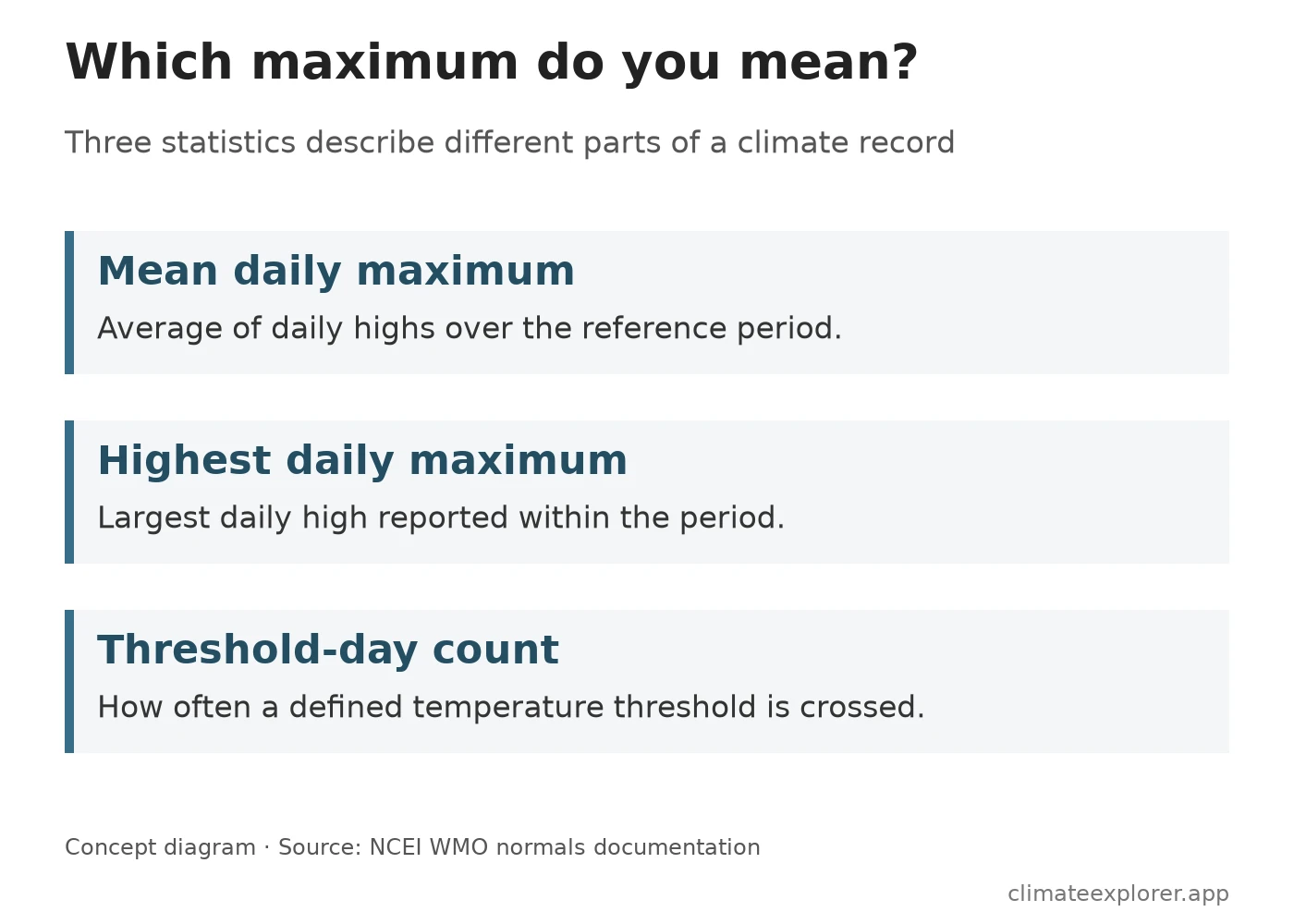
A hot afternoon compared with a station’s “normal maximum temperature” can produce a striking difference. But that normal usually means the average of daily maximum temperatures for a particular calendar month, not the highest temperature the station has ever recorded. The comparison needs a label that tells readers which statistic is on each side.
WMO climatological standard normals provide a shared reference period, 1991–2020 as of September 2026. They help describe a station’s climate and put observations in context. Their limits come from the statistic, period and location chosen—not simply from the age of the data.
Read the statistic before the number
The NOAA NCEI description of WMO normals lists mean daily maximum, minimum and mean temperature among the principal elements. These are different summaries. A month’s mean daily maximum concerns the day’s high; the mean daily temperature includes a different part of the daily temperature cycle.
Some submissions also include threshold-day counts, extreme values and measures of variability. Normals are not limited to simple averages. What a mean cannot tell you may be available in another field—but the additional field must actually be reported for the station.
For example, compare an observed July monthly mean with the station’s July mean-temperature normal to describe that month’s departure from the reference. Comparing one afternoon’s temperature with the July mean daily maximum can still illustrate context, but call it a comparison between those two quantities. It is not a monthly-mean anomaly or proof of a record.
A fixed period gives a stable reference
The WMO explanation of reference periods distinguishes the most recent 30-year standard period from longer-term climate-change reference periods. WMO uses 1991–2020 for many operational applications and retains 1961–1990 as a fixed reference for long-term climate-change assessment.
A baseline does not acquire new years as conditions change. If a location has warmed since 2020, the 1991–2020 value cannot incorporate that later warming. It remains useful precisely because the reference is identifiable and stable. Always state the period when reporting a departure from normal.
Changing the reference period can also change the size of an anomaly without changing the observation. Two charts can therefore report different departures for the same month if they use different normals. Check the baseline before treating the charts as contradictory.
One average cannot reveal the sequence
A single 30-year mean does not show whether conditions rose steadily, shifted abruptly or fluctuated around a stable level during those decades. To examine change through time, use a historical series and a documented method, such as the Heathrow monthly-temperature example.
Likewise, a precipitation normal by itself cannot show how rain was distributed through a particular month. Threshold counts or period extremes can add information where supplied, but they still summarize the reference period. To reconstruct a flood-producing rain sequence or the duration of a hot spell, return to daily or shorter-interval observations.
Match the station as well as the month
An airport, a city-centre observatory and a hillside station can experience different conditions. Their normals belong to their respective observing sites. Before using one as a reference for another, check location, elevation, exposure and station history.
Data availability also varies. NCEI publishes the national submissions and notes differences in documentation, parameter coverage and the number of years used. A 30-year reference window does not automatically prove that every value uses 30 complete years of observations. Inspect the accompanying year counts and country notes where available.
Choose the comparison you actually need
Use the WMO Normals Explorer to inspect available station parameters. The station charts and CSV guide explains selection, monthly tables and export. Before using a value, write down its station, parameter, calendar month, reference period and unit.
That short description prevents several common mistakes. It distinguishes a normal from a record, a monthly average from a single hot afternoon, and a point measurement from a regional climate. Add a time series or other stations when the question needs information the chosen normal does not contain.
Data Annex
This is a conceptual explanation; no new station trend or anomaly is calculated. The examples distinguish statistical definitions rather than comparing two measured stations.
| Reference detail | Interpretation |
|---|---|
| Standard period discussed | 1 January 1991–31 December 2020 |
| Spatial unit in the collection | Reporting station |
| Principal temperature elements | Mean daily maximum, mean daily minimum and mean daily mean temperature |
| Additional elements | May include threshold counts, period extremes or variability statistics |
| Completeness | Check reported year counts, station information and country documentation |
| Reader question | Appropriate evidence |
|---|---|
| How unusual was a month’s mean temperature? | The month’s mean and a matching station/month mean-temperature normal |
| Was a particular day a record? | Comparable daily extrema and the documented period of record |
| Are hot days becoming more frequent? | A time series of consistently defined threshold counts |
| Does the result describe a whole region? | Multiple representative stations or an appropriate spatial dataset |
Data Sources
- WMO climatological normals: definitions and reference-period guidance.
- WMO: updated 30-year reference period: operational and long-term reference periods.
- NOAA NCEI WMO Climate Normals: principal and additional elements, station files, year counts and country documentation.