Warm June Nights: What Six Station Series Can Tell Us
At Paris-Montsouris, the lowest available temperature report on June 25, 2026 was 26.4°C. That is a warm reading even for the coolest reported part of a day. Five other European station series also contained days whose lowest report was above 20°C.
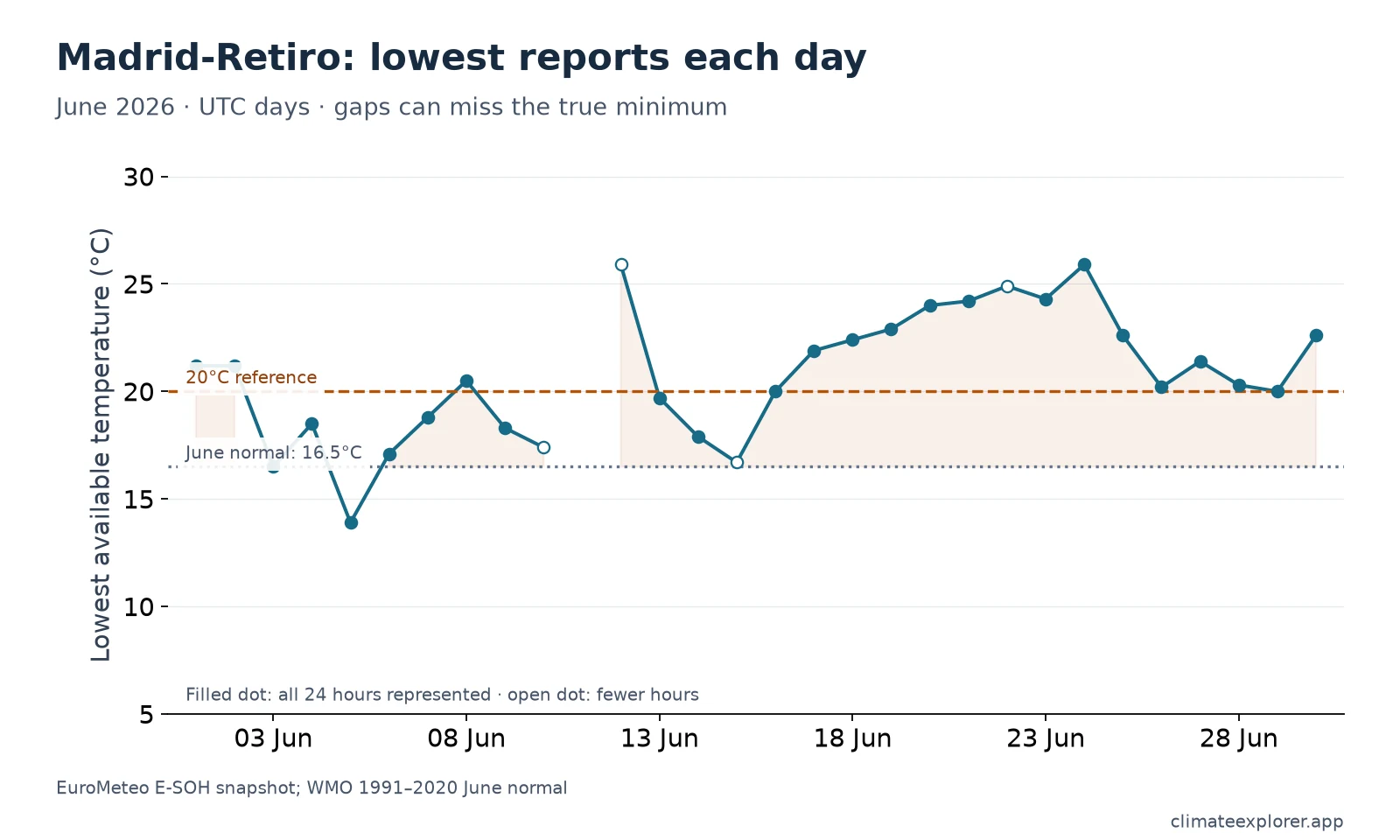
But an archive of hourly reports does not necessarily capture the true daily minimum. Missing hours can hide cooler temperatures. Madrid’s highest minimum report, 25.9°C on June 12, comes from just 14 represented hours. It should not be presented as proof that the temperature stayed that high through a whole night.
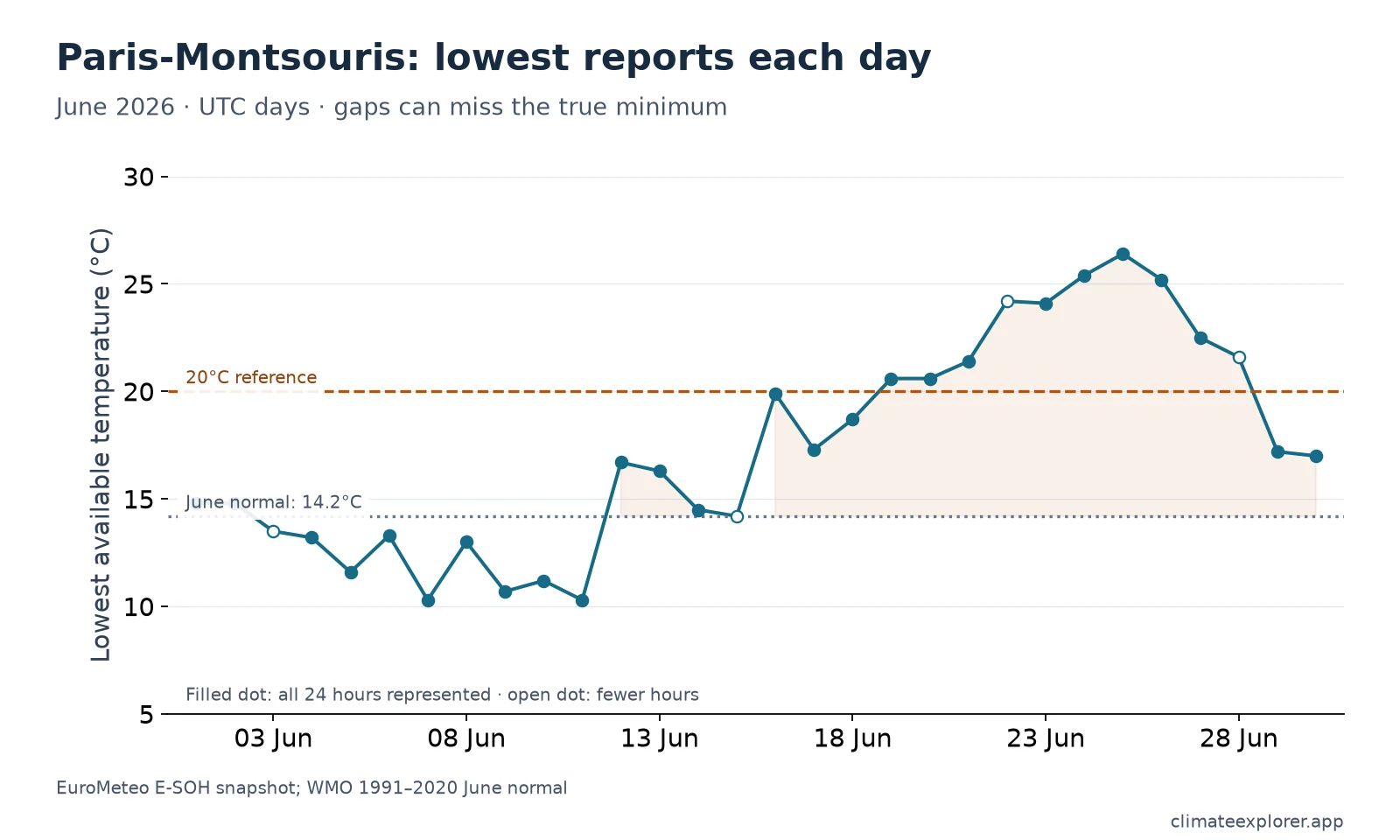
A warm report and a tropical-night classification are different checks
The familiar 20°C (68°F) tropical-night reference is useful when reading these series. Applying a formal classification also requires the relevant observing window and a sufficiently complete minimum-temperature record.
Here, each point is the smallest valid air_temperature value available between 00:00 and 23:59 UTC. Those boundaries need not match a national daily product or one local night. The figure therefore labels the values as lowest reports, rather than official tropical-night minima.
A filled marker means at least one report exists in every UTC hour. An open marker means one or more hours are absent. Neither symbol certifies continuous measurement, a final provider quality status or equal sampling frequency between stations. Multiple streams can supply reports within an hour.
Coverage changes the reading of Madrid
Madrid has 29 observed June dates in the retained feed; June 11 is absent. June 12 has only 14 represented hours, and the least-covered Madrid date has 11. The chart leaves the missing date as a gap. Joining a line across it would suggest continuity the data do not provide.
Madrid recorded the same lowest report, 25.9°C, on June 24, with all 24 hours represented. The equal values therefore have different observational support; both dates are retained in the table.
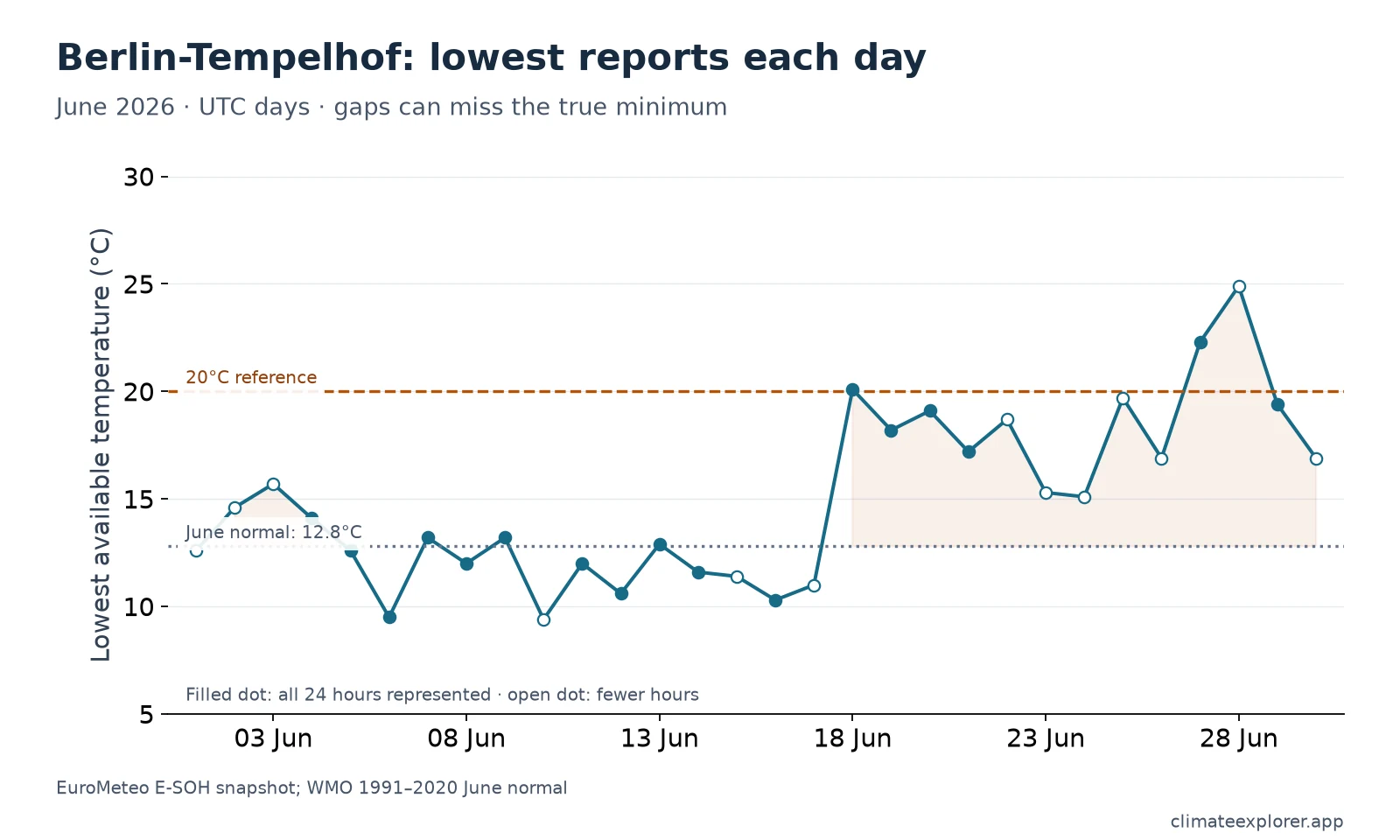
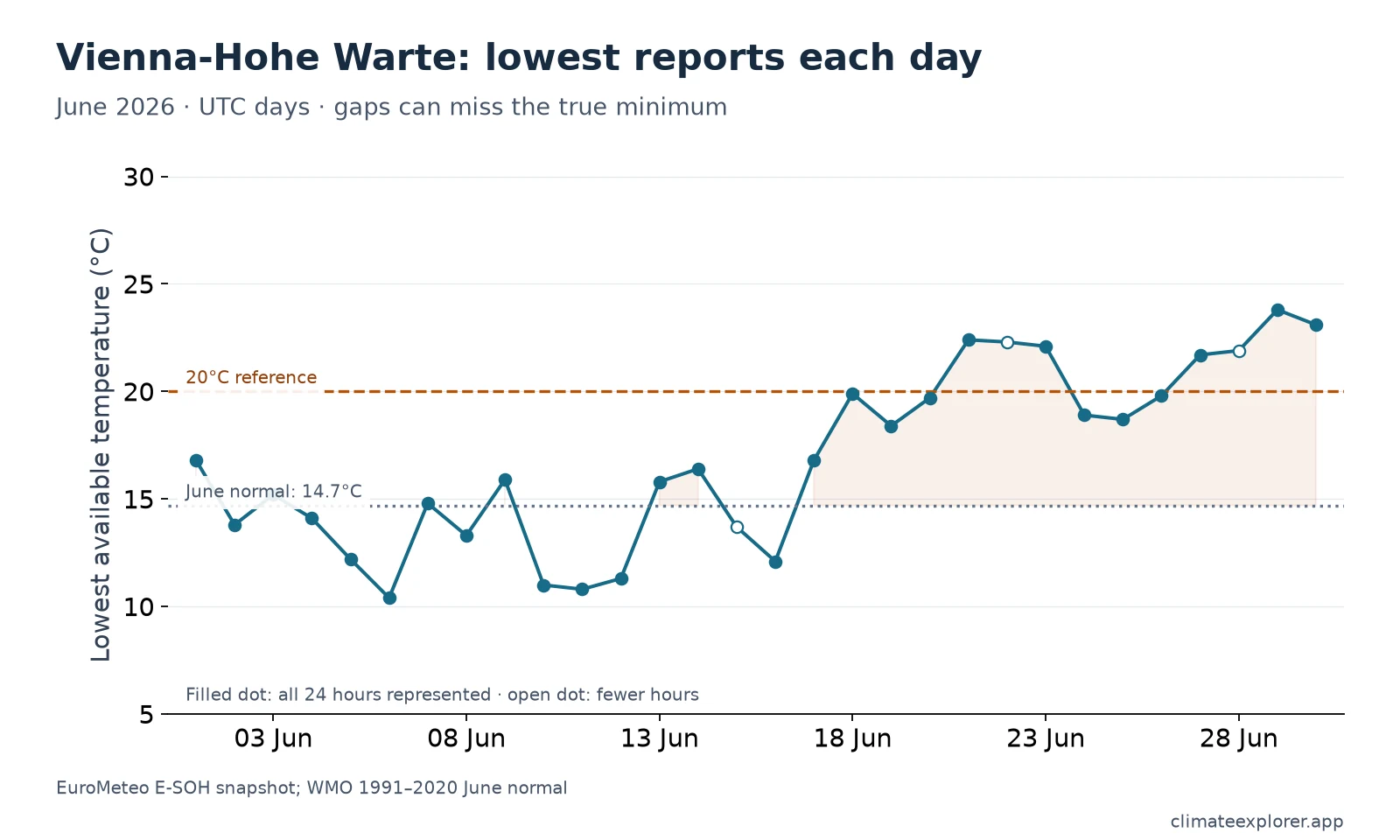
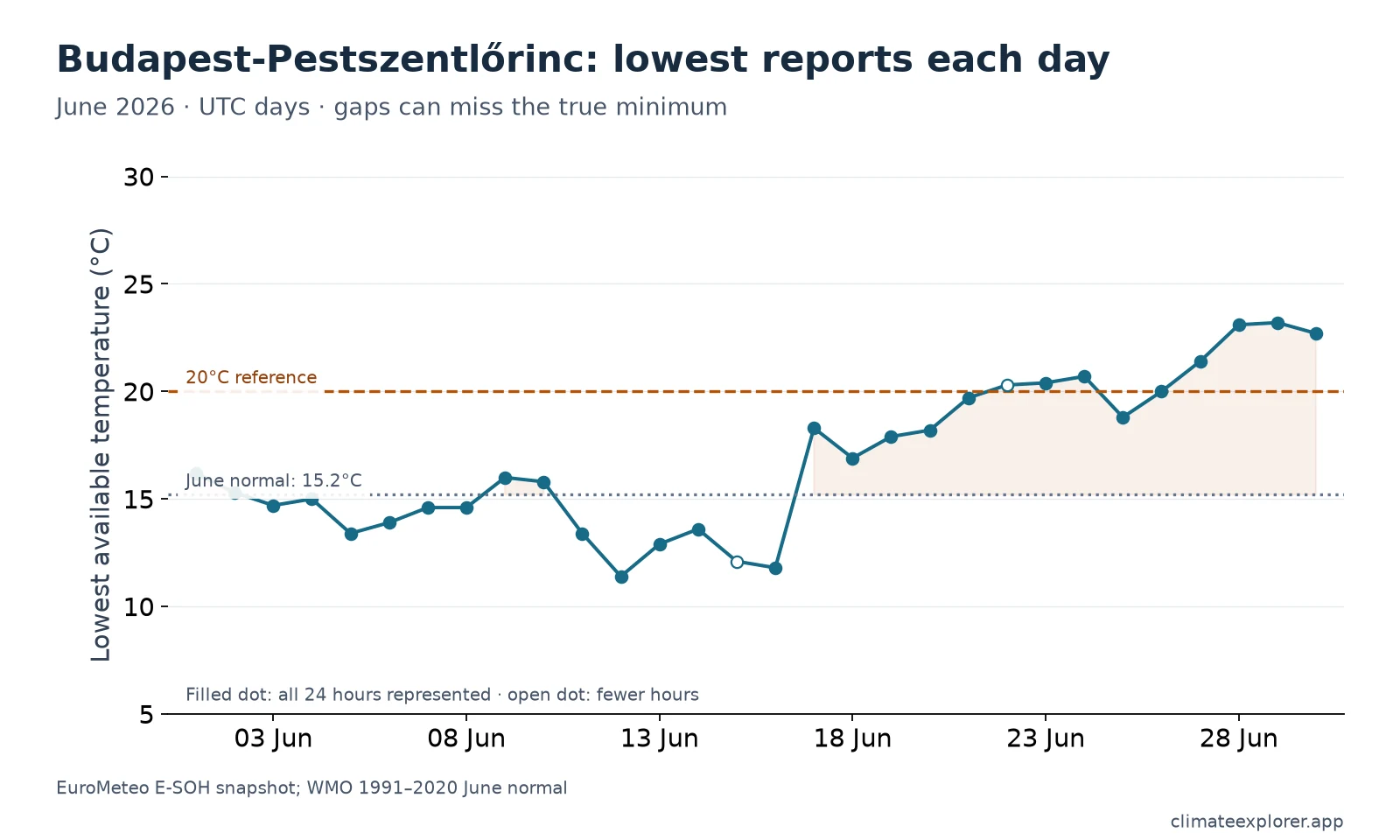
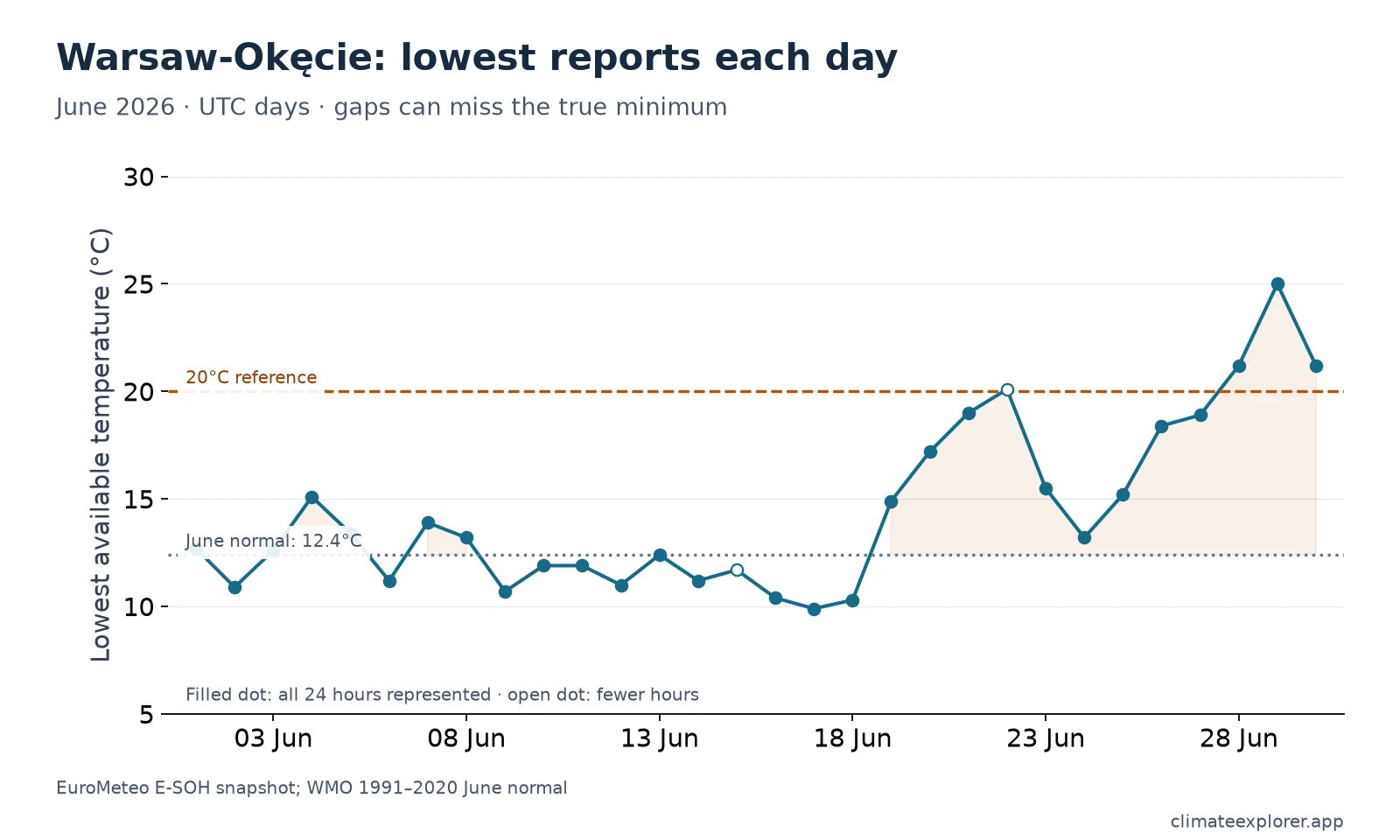
For comparison, the highest minimum reports at Vienna, Budapest, Warsaw and Paris each have observations in all 24 hours. Berlin’s June 28 value has 23. The table below keeps that coverage beside the temperature, so the six peak values do not look equally well observed.
The other five series
Madrid-Retiro
Berlin-Tempelhof
Vienna-Hohe Warte
Budapest-Pestszentlőrinc
Warsaw-Okęcie
Use the normal as context
The dotted lines are 1991–2020 WMO June mean daily minimum temperatures. They describe an average June minimum at each station, not a calendar-day expectation or an extreme threshold. Subtracting one from a single day’s lowest report supplies context, but the sampling limits remain.
The station identifiers matter too. These are individual sites—Retiro, Tempelhof and Okęcie, for example—not average temperatures across their respective cities. The EuroMeteo guide explains how to inspect station observations; the WMO normals explainer explains the reference statistics.
Conclusion
Observational series from six European capitals reveal widespread, pronounced nocturnal heat during late June 2026, with lowest available daily reports sitting 8°C to nearly 13°C above 1991–2020 WMO June mean minimum baselines. Paris-Montsouris reached an elevated minimum report of 26.4°C on 25 June, while Berlin-Tempelhof and Warsaw-Okęcie each reported minimums near 25°C late in the month. Crucially, examining report coverage alongside raw values shows that operational point feeds with missing hours cannot definitively confirm a climatological tropical night, as unobserved cooler periods may have occurred. Distinguishing raw interim reports from validated 24-hour minimums is necessary for accurate climatological interpretation.
Editor’s note: Data current as of June 30, 2026. Hourly observations, coverage totals and WMO 1991–2020 station baselines were rechecked against E-SOH parquet archives on September 13, 2026. Upstream feeds remain subject to subsequent quality control by national providers.
Frequently Asked Questions
Does a minimum report above 20°C prove a tropical night?
No. Missing or infrequent reports may omit cooler temperatures, and UTC calendar days may differ from the observing window used for an official tropical-night classification.
Does a filled circle mean there are no data gaps?
It means each of the 24 UTC hours contains at least one report. It does not mean that every minute was observed or that the true daily minimum was captured.
Data Annex
Station metadata
| Station | Observation WIGOS ID | WMO normals ID | Latitude | Longitude | Elevation |
|---|---|---|---|---|---|
| Paris-Montsouris | 0-250-0-07156 |
07156 |
48.8217° N | 2.3378° E | 75 m |
| Madrid-Retiro | 0-20000-0-08222 |
08222 |
40.4118° N | 3.6781° W | 667 m |
| Berlin-Tempelhof | 0-20000-0-10384 |
10384 |
52.4676° N | 13.4020° E | 47.7 m |
| Vienna-Hohe Warte | 0-20000-0-11035 |
11035 |
48.2486° N | 16.3564° E | 198 m |
| Budapest-Pestszentlőrinc | 0-348-1-44527 |
12843 |
47.4292° N | 19.1822° E | 138.1 m |
| Warsaw-Okęcie | 0-20000-0-12375 |
12375 |
52.1667° N | 20.9667° E | 106.5 m |
WIGOS IDs identify the observation-feed stations; the five-digit IDs identify the corresponding rows in the normals archive. Coordinates and elevations shown here come from the maintained observation metadata. The normals CSV stores a discrepant longitude for Warsaw-Okęcie, but its legacy ID and station name match the observation station.
A WIGOS ID is a globally unique station identifier. The baseline join preserves the separately verified legacy WMO ID; it does not derive station identity from a city name alone.
Highest minimum reports and their coverage
| Station | UTC date | Lowest report (°C) | Hours represented | June normal (°C) | Difference (°C) |
|---|---|---|---|---|---|
| Paris-Montsouris | 2026-06-25 | 26.4 | 24 | 14.2 | +12.2 |
| Madrid-Retiro | 2026-06-12 | 25.9 | 14 | 16.5 | +9.4 |
| Madrid-Retiro | 2026-06-24 | 25.9 | 24 | 16.5 | +9.4 |
| Berlin-Tempelhof | 2026-06-28 | 24.9 | 23 | 12.8 | +12.1 |
| Vienna-Hohe Warte | 2026-06-29 | 23.8 | 24 | 14.7 | +9.1 |
| Budapest-Pestszentlőrinc | 2026-06-29 | 23.2 | 24 | 15.2 | +8.0 |
| Warsaw-Okęcie | 2026-06-29 | 25.0 | 24 | 12.4 | +12.6 |
The calculation reads all 30 daily parquet files for June, explicitly filters timestamps to June 1–30 UTC and retains air_temperature between −50°C and 60°C. These broad plausibility bounds do not replace provider quality control. There are 179 station-days across the six sites. No absent day or hour is interpolated. Report counts and distinct represented hours are separate columns in the complete chart-ready CSV.
The six baseline values were re-extracted from the WMO normals composite on September 13, 2026. This revision rechecks the retained June observation snapshot; it does not claim that the live feed still contains exactly the same reports.
Data Sources
- EUMETNET MeteoGate: the upstream cross-border observation service used by EuroMeteo.
- NOAA NCEI WMO Climate Normals: archive of the WMO 1991–2020 station baselines.
- WMO climatological normals: definition of the reference period.