MeteoSwiss Weather Station Guide: SwissMetNet, Live & NBCN
Open the interactive MeteoSwiss station explorer
Quick start
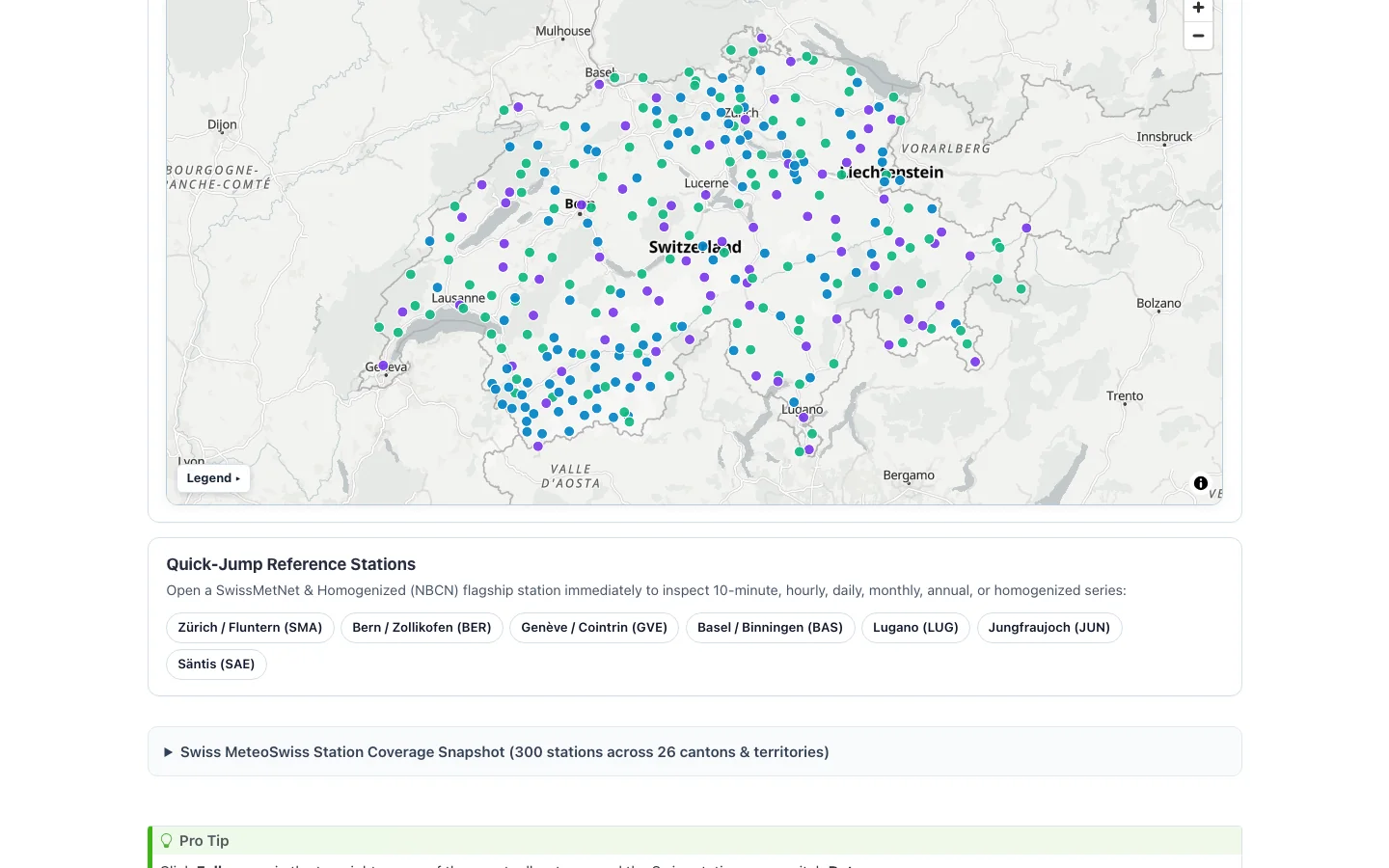
- Open the MeteoSwiss Weather & Climate Station Explorer and narrow by Canton / Territory (all 26 Swiss cantons plus Liechtenstein) or search Station Search by station name, 3–5 character MeteoSwiss abbreviation (for example
SMA,BER,BAS,GVE,LUG,SAE), or 5-digit WMO ID (06660). - Select a Data Resolution (10-Min (+ Live), Hourly (+ Live), Daily, Monthly, Annual, or Homogenized (NBCN)), adjust Date Range (UTC) or quick presets (
3 DaystoFull Record), and toggle Metric (°C, mm) or Imperial (°F, in). - Inspect the Station Dashboard metadata banner, data-driven summary narrative, KPI cards, and interactive Plotly charts, or switch between Annual, Monthly, and Daily cadence inside Homogenized (NBCN) mode.
- Open Data Table to review source provenance (
historical,recent,live,nbcn) and UTC timestamps, then click Export CSV to download clean, BOM-free records with mandatorySource: MeteoSwiss (CC BY 4.0)attribution.
What this guide helps you do
The MeteoSwiss Weather & Climate Station Explorer streams 300 Swiss and Liechtenstein meteorological stations (158 multi-parameter SwissMetNet automatic stations and 142 automatic precipitation gauges, including 75 homogenized NBCN sites) directly in your browser from MeteoSwiss Open Government Data (https://data.geo.admin.ch, CC BY 4.0) with no API key or backend proxy.
Use this guide when you want to:
- locate stations across
ogd-smn,ogd-smn-precip,ogd-nbcn, andogd-nbcn-precipwithout mixing raw and homogenized series; - bridge
_historicaland_recentarchive files up to the current 10-minute or hourly reading with provisional_nowtelemetry; - distinguish MeteoSwiss
06:00–06:00 UTCclimatological daily precipitation (rre150d0) from calendar-day totals (rka150d0) and interpret gap-broken morning snow depth (htoautd0); - check WMO-gated OLS warming trends, 1991–2020 NBCN departures, WMO crosswalk links, and exported CSV schemas.
Select a canton, network, and station
- Canton / Territory filters the 300-station network across all 26 Swiss cantons (
AGthroughZH) plus Liechtenstein (FL, with stations at Vaduz, Schaan, and Malbun). - Station Search ranks exact abbreviation (
SMA,BER,GVE,LUG,SAE,JUN), WMO ID (06660,06700,06680), and accent-insensitive name matches (Zürichorzuerich). - Network Coverage filters the map and Stations directory by
All Stations (300),SwissMetNet Full (158),Homogenized NBCN (75),NBCN Full Climate (29), orPrecipitation Gauges (142). - Map View opens on a Flat (2D) Mercator viewport framed tightly on Switzerland and Liechtenstein (
45.75°N–47.85°N,5.85°E–10.60°E), with Globe (3D), Satellite imagery, Labels, Reset Map, and Fullscreen (Escto exit). - Clean shareable URLs: Every canton and station maps to a deterministic route such as /explorers/meteoswiss/zurich/zuerich-fluntern/, preserving resolution, dates, and units in query parameters.
Resolutions, file stitching, and _now precedence
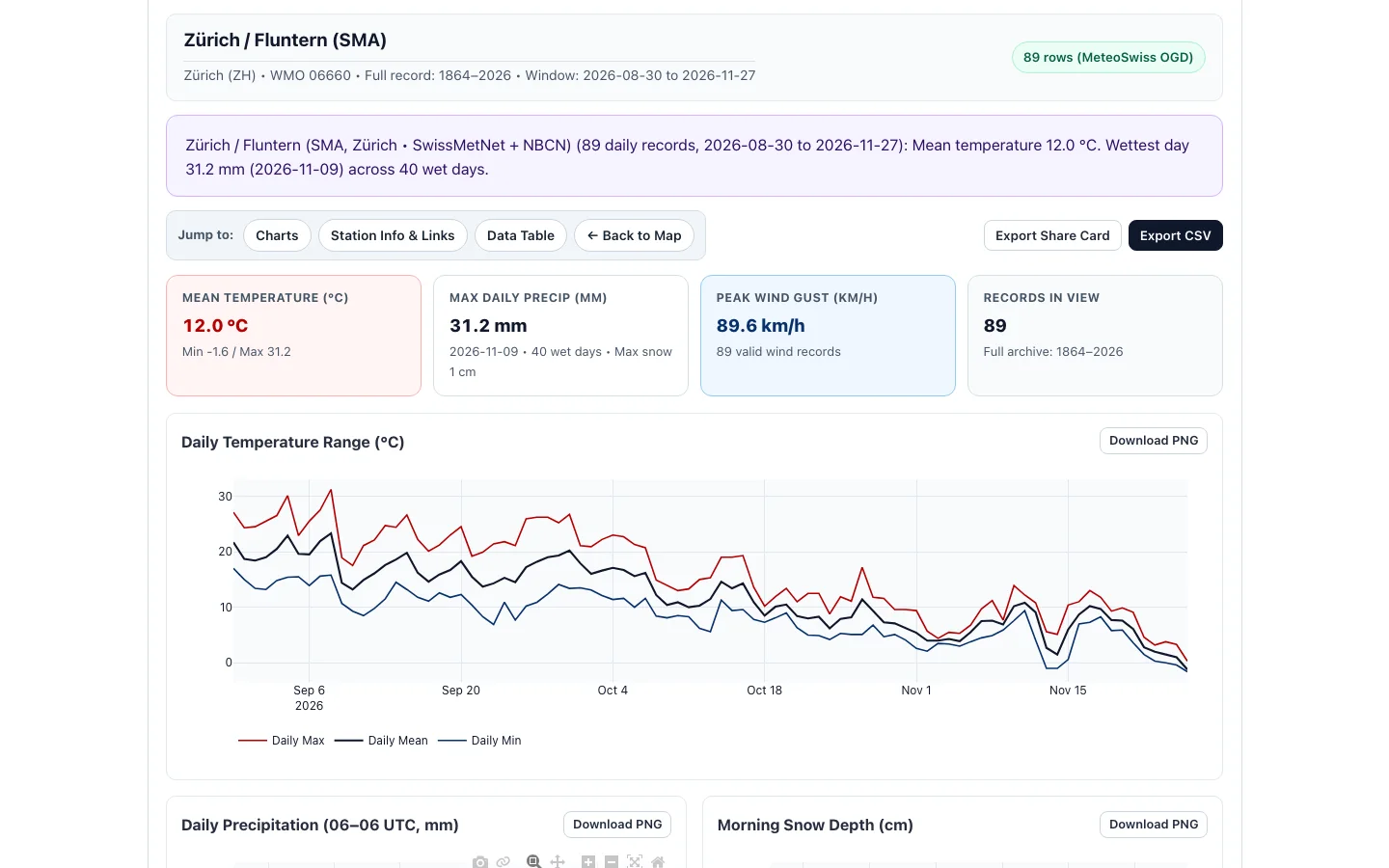
Because MeteoSwiss publishes open observations as semicolon-delimited (;), Windows-1252 (cp1252) CSV files partitioned by time tier on data.geo.admin.ch, Climate Explorer decodes every response explicitly with TextDecoder("windows-1252") (preserving umlauts and accents such as Zürich, Säntis, and Genève) and fetches only the files overlapping your selected UTC window:
- 10-Min (+ Live) (
t, bounded to 14 days per request) & Hourly (+ Live) (h, bounded to 90 days): Fetches any overlapping decade archive (_historical_<YYYY-YYYY>.csv), current-year_recent.csv, and near-real-time_now.csv. - Archive precedence on duplicate timestamps: Rows are deduplicated on UTC
reference_timestamp. Validated_historicaland_recentarchive rows always supersede provisional_nowobservations; remaining unarchived_nowrows carry thelivesource tag and a soft-purple provenance pill in the dashboard banner. - Daily (
d): Bridges_d_historical.csvand_d_recent.csvacross full archive spans (defaulting to the latest 90 days on load). - Monthly (
m) & Annual (y): Streams single-file station summaries (_m.csv,_y.csv). For Precipitation Gauge (ogd-smn-precip) stations without continuous multi-parameter sensors, precipitation and available snow/temperature columns are surfaced without fabricating missing meteorological variables.
Inspect Homogenized (NBCN) climate series
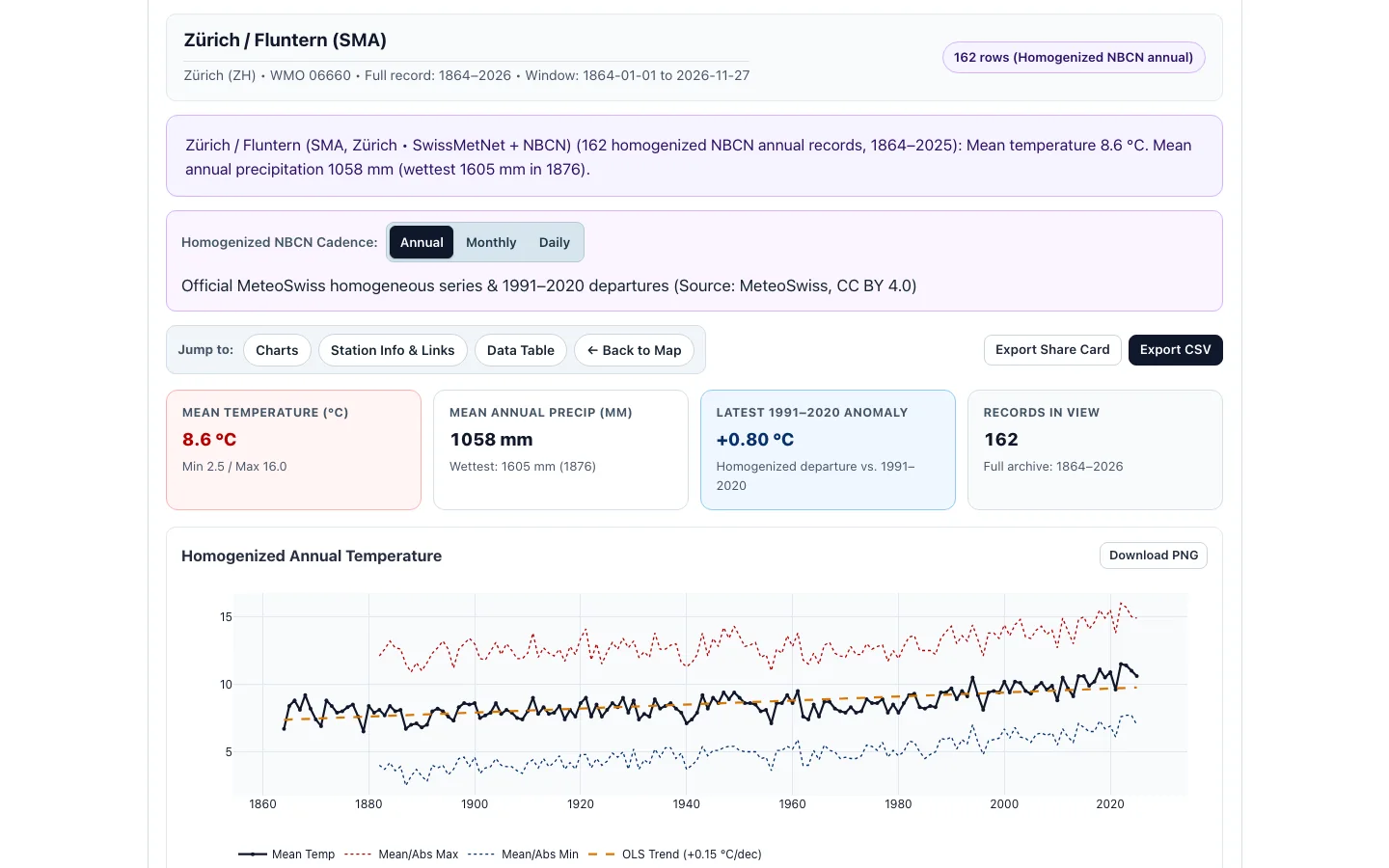
Raw automatic station series reflect historical site relocations, screen replacements, and sensor transitions. On the 75 NBCN stations (29 full-climate sites in ogd-nbcn such as SMA, BER, BAS, GVE, LUG, SAE, plus 46 homogenized precipitation sites in ogd-nbcn-precip), switching Data Resolution to Homogenized (NBCN) keeps homogenized data strictly separate from unadjusted SwissMetNet measurements:
- Cadence selector (
Annual/Monthly/Daily):ogd-nbcnstations offer Annual, Monthly, and Daily homogenized temperature (ths200*) plus official 1991–2020 temperature departures (th9120*) and precipitation percentages (rh9120*). Precipitation-onlyogd-nbcn-precipsites provide Monthly and Annual homogenized precipitation (rhs150*) back to the 19th century. - WMO-gated OLS trend slopes: Descriptive linear regression lines are plotted on Annual charts only when a series passes all four completeness gates: at least 24 valid years, a span of at least 30 years, at least 80% data completeness across the span, and no consecutive gap exceeding 10 years. Slopes are reported strictly in °C/decade or mm/decade.
- WMO Crosswalk links: Under Station Info & Links, stations with a 5-digit WMO ID (
06xxx) surface verified links to companion Climate Explorer tools (WMO Climate Normals,WMO CLIMAT Monthly,NOAA GHCNh,NOAA GHCNm,NOAA SSOD).
Key parameters, UTC windows, and precipitation rules
All timestamps in MeteoSwiss OGD CSVs are reported in UTC (DD.MM.YYYY HH:MM). Missing calendar steps and zero snow depths insert clean Plotly gap breaks (connectgaps: false) rather than interpolating across missing intervals, and Snow Depth shades positive values cleanly (breakOnZero).
| Concept / Parameter | MeteoSwiss Code | Explorer Display & Scientific Rule |
|---|---|---|
| 2 m air temperature | tre200s0, tre200h0, tre200d0 |
Decoded from cp1252 CSV in °C; converted to °F when Imperial is selected. Daily also exposes tre200dx (max) and tre200dn (min). |
Climatological daily precip (06–06 UTC) |
rre150d0 |
Official 24-hour MeteoSwiss climatological accumulation from 06:00 UTC of the reference date to 06:00 UTC the next morning (mm / in). Primary Daily precip KPI & chart trace. |
Calendar-day precip (00–00 UTC) |
rka150d0 |
Calendar-day precipitation sum (00:00–00:00 UTC), preserved alongside rre150d0 in the Daily Data Table and CSV export for cross-dataset comparison. |
| Morning snow depth | htoautd0, htoauts0 |
Total snow depth (cm / in); plotted with zero-segmented breakOnZero intervals so snow-free summer months do not connect flat lines across gaps. |
| Wind speed & gusts | fu3010* (km/h), fkl010* (m/s) |
Unit-normalized into km/h (Metric) or mph (Imperial); raw m/s columns (fkl010*) are scaled by 3.6 when fu3010* is absent. |
| Sunshine & solar radiation | sre000*, gre000d0 |
Sub-daily sunshine is kept in minutes; Daily, Monthly, Annual, and NBCN sunshine are converted to hours (÷ 60). Global radiation uses W/m². |
| Homogenized NBCN & 1991–2020 norms | ths200*, rhs150*, th9120*, rh9120* |
Statistically adjusted series (1864–present) kept isolated inside Homogenized (NBCN) mode alongside official 1991–2020 temperature departures (°C) and precip ratios (%). |
Review the Data Table and export CSV
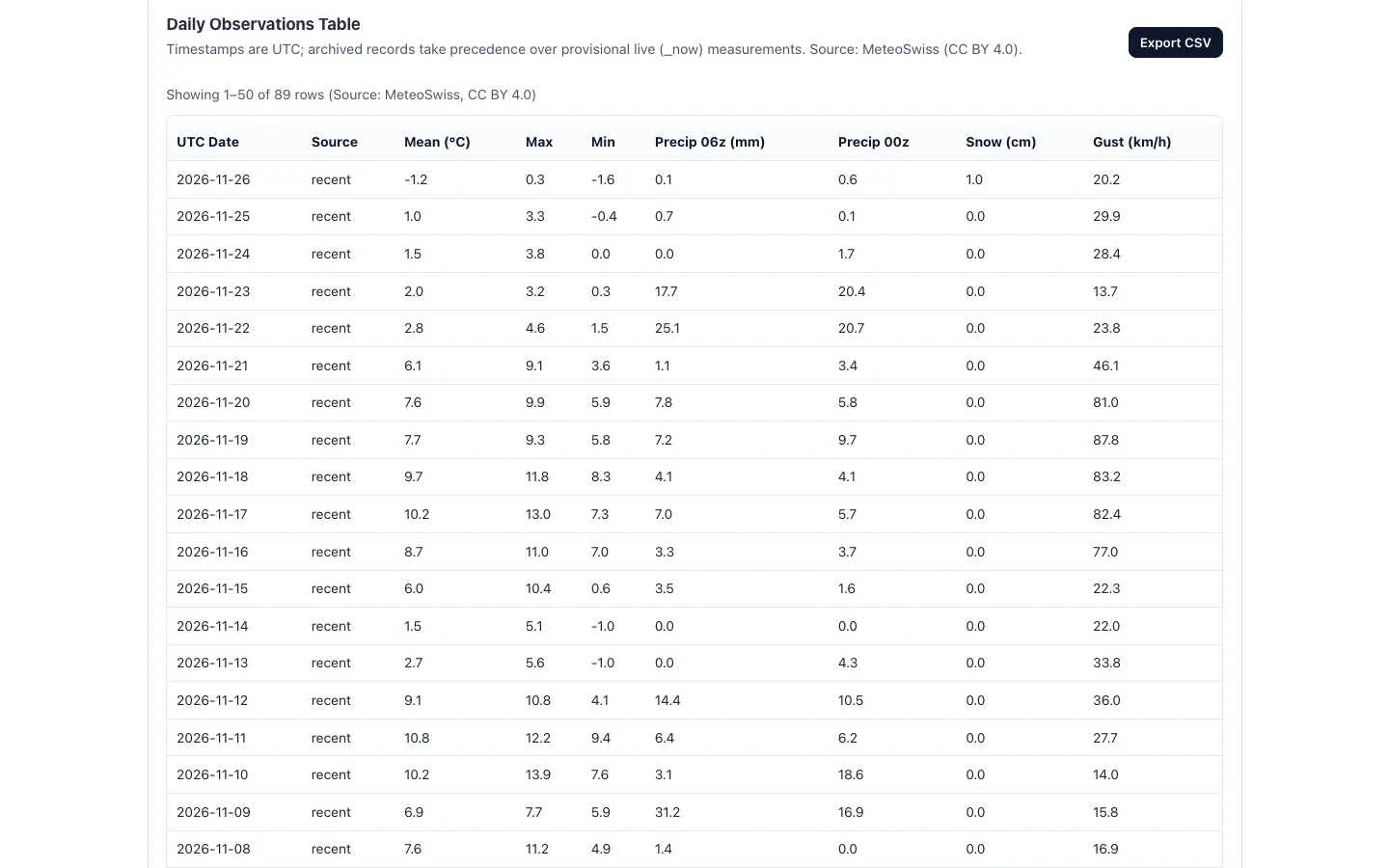
Switch to the Data Table tab to inspect exact numeric values alongside each row’s Source (historical, recent, live, nbcn) before downloading:
- Unit synchronization: Switching Display Units between
Metric(°C,mm,cm,km/h,hPa) andImperial(°F,in,mph,inHg) updates all KPI cards, Plotly traces, table headers, and CSV columns together. - CSV export safety & licensing: Export CSV outputs clean UTF-8 without a byte-order mark (BOM-free), neutralizes spreadsheet formula prefixes (
=,+,-,@), preserves bothprecip_06utcandprecip_00utcon Daily exports, and embedsSource: MeteoSwiss (CC BY 4.0)in an explicitattributioncolumn.
Worked example: Inspect Zürich / Fluntern (SMA)
- Open Zürich / Fluntern (
SMA) in Zürich. - In Daily mode, compare
precip_06utc(06:00–06:00 UTC) andprecip_00utc(00:00–00:00 UTC) columns in Data Table and review temperature/snow/wind plots on the Station Dashboard. - Switch Data Resolution to 10-Min (+ Live) to see
_recentobservations extended smoothly by live_nowreadings with the soft-purple provenance pill (Archive + Live _now). - Switch to Homogenized (NBCN) and pick Annual cadence to examine Zürich’s
1864–2025homogenized temperature record, 1991–2020 anomaly, and WMO-gated warming slope, or click Export CSV.
Troubleshooting
- Why does a Precipitation Gauge station only plot rainfall or lack 10-minute/hourly buttons?
-
MeteoSwiss separates 158 multi-parameter SwissMetNet (
ogd-smn) sites from 142 dedicated automatic precipitation gauges (ogd-smn-precip). Precipitation-only sites do not measure air temperature, pressure, or sunshine, and the resolution bar automatically enables only cadences available in MeteoSwiss OGD for the selected station. - Why does Homogenized (NBCN) offer Annual & Monthly only on a precipitation station such as Affoltern i. E. (
AIE)? -
The 29 core
ogd-nbcnclimate stations publish daily, monthly, and annual homogenized temperature & precipitation files, whereas the 46ogd-nbcn-precipgauges publish monthly (_m.csv) and annual (_y.csv) homogenized precipitation only. Choosing a station without NBCN status disables the NBCN toggle instead of mixing unadjusted data. - Why do
rre150d0(06z) andrka150d0(00z) differ on the same Daily row? -
Storm precipitation falling between
00:00 UTCand06:00 UTCbelongs to the00:00–00:00 UTCcalendar day of that morning (rka150d0) or the previous day’s06:00–06:00 UTCclimatological window (rre150d0). Both columns are exported so you can match whichever convention your reference dataset uses. - Why is the Annual OLS warming trend omitted on a shorter station?
-
Trend lines are suppressed whenever a station has fewer than 24 complete years, spans less than 30 years, falls below 80% completeness, or contains a multi-year gap longer than 10 years. The exact gate reason appears in the trend status readout.
- Why did recent
_nowvalues disappear after re-querying a few hours later? -
Live
_nowtelemetry is provisional and continually superseded by quality-checked_recentand_historicalarchive files ondata.geo.admin.ch. Once archived values overlap a timestamp, the Explorer replaces the provisional row automatically.