Japan Meteorological Agency (JMA): Exploring One of the World’s Largest Weather Station Networks
The Japan Meteorological Agency: A Pillar of Global Observation
The Japan Meteorological Agency (JMA), established in 1875, is one of the oldest and most technically advanced national meteorological services in the world. Operating under the Ministry of Land, Infrastructure, Transport and Tourism, the JMA is responsible for weather forecasting, earthquake and tsunami warnings, and—critically for climate science—the operation and maintenance of one of the densest surface weather observation networks on Earth.
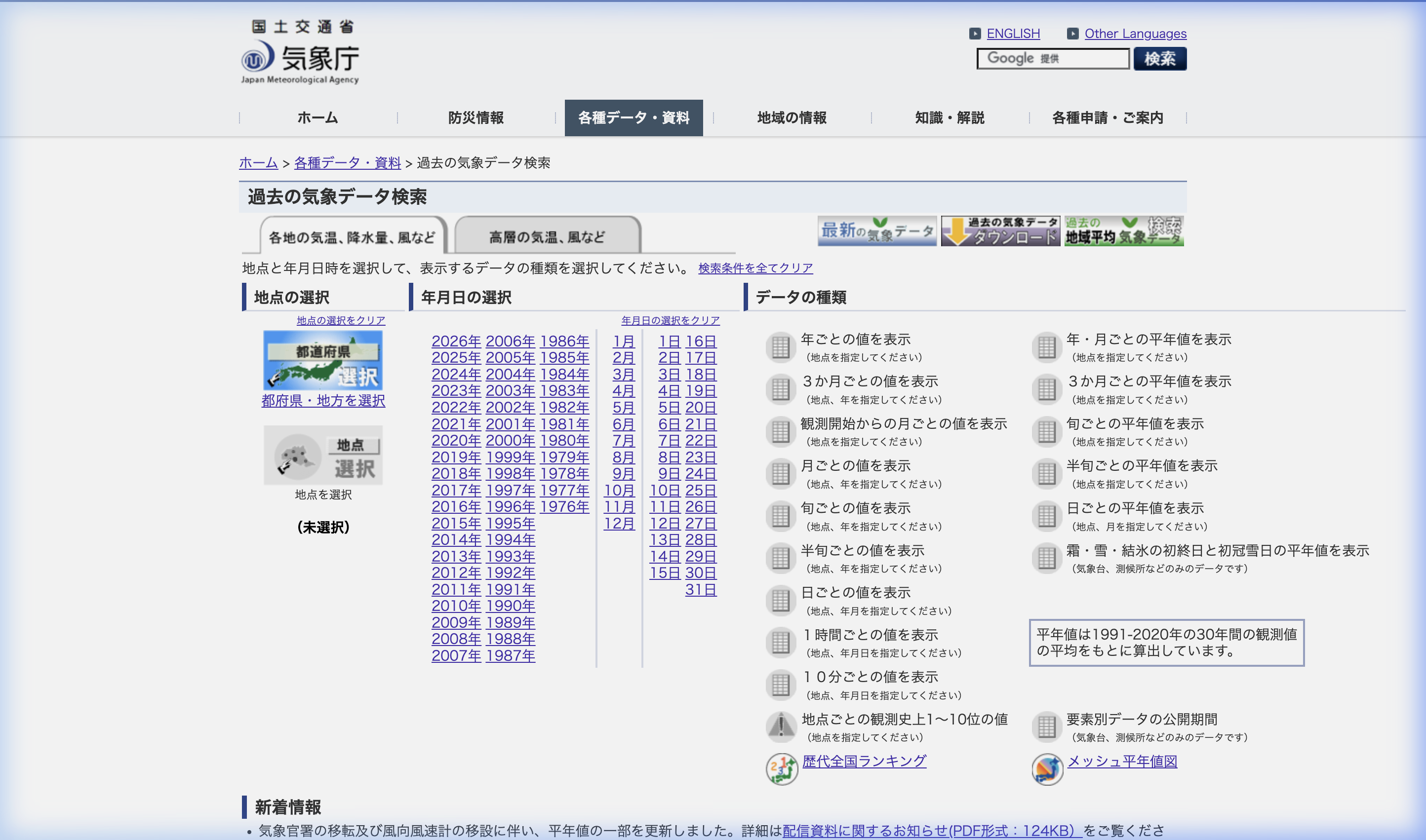
What sets the JMA apart is the sheer depth and accessibility of its historical weather station data. Through its publicly accessible data portal at data.jma.go.jp, the agency provides free access to decades of quality-controlled observations from over 1,600 weather stations scattered across the entire Japanese archipelago, from the subarctic reaches of Hokkaido to the subtropical islands of Okinawa.
The Station Network: Synoptic Observatories and AMeDAS
The JMA’s observation network is built on two complementary pillars, each serving a distinct yet interconnected purpose.
Manned Synoptic Stations (S1)
The backbone of Japan’s climate record consists of approximately 150 manned synoptic stations. These are traditional, staffed meteorological observatories that have been operating, in many cases, for well over a century. Iconic stations like Tokyo (since 1876), Kyoto (since 1880), Osaka (since 1883), and Hakodate (since 1873) provide unbroken climate records stretching back to the Meiji era—an extraordinarily valuable resource for studying long-term climate change in East Asia.
These synoptic stations measure a comprehensive suite of meteorological variables:
- Atmospheric Pressure (station-level and sea-level)
- Air Temperature (mean, maximum, minimum)
- Relative Humidity (mean and minimum)
- Wind Speed and Direction (mean, maximum sustained, and gusts)
- Sunshine Duration
- Precipitation (total, maximum hourly, maximum 10-minute)
The long, continuous records from these observatories are indispensable for calibrating climate models and establishing baseline trends against which modern warming can be measured.
The AMeDAS Network (A1)
Complementing the manned stations is the Automated Meteorological Data Acquisition System (AMeDAS), a vast network of over 1,300 automated weather stations deployed across Japan since the mid-1970s. AMeDAS stations are positioned with an average spacing of approximately 17 km, providing extraordinarily dense spatial coverage.
While AMeDAS stations typically measure fewer variables than their manned counterparts (focusing on precipitation, temperature, and wind), their sheer density makes them the backbone of Japan’s real-time weather monitoring, nowcasting, and disaster warning systems. Many AMeDAS stations are located in remote mountainous areas, on small islands, and at high elevations—places where manned observation would be impractical—capturing the full diversity of Japan’s complex topography and microclimates.
Temporal Resolution: From Monthly Summaries to 10-Minute Intervals
One of the most remarkable aspects of the JMA’s open data is the range of temporal resolutions available for download. For both synoptic and AMeDAS stations, data can be accessed at:
- Monthly resolution — ideal for long-term climate trend analysis and seasonal studies.
- Daily resolution — the standard for climatological baselines, covering variables like daily mean/max/min temperature, total precipitation, average wind speed, and sunshine hours.
- Hourly resolution — critical for studying the diurnal cycle of weather variables, urban heat island effects, and short-term meteorological events.
- 10-Minute resolution — the highest granularity available, essential for analyzing extreme weather events such as intense convective rainfall, sudden wind gusts during typhoon passage, and rapid pressure changes.
This multi-resolution approach allows researchers to zoom in on specific meteorological phenomena at the temporal scale most appropriate for their analysis.
Accessing the Data: How JMA’s Portal Works
Unlike many European meteorological services that now offer unified REST APIs (driven by EU Open Data legislation), the JMA provides its observational data through a web-based data portal at www.data.jma.go.jp. Users can browse stations by prefecture, select a time period and resolution, and view the data directly in structured HTML tables.
Each data request is constructed from three key parameters:
- Prefecture Number (
prec_no) — Japan is divided into meteorological regions, each identified by a numeric code (e.g., 44 for Tokyo, 61 for Kyoto, 91 for Okinawa). - Station Block Number (
block_no) — A unique identifier for each individual station within a prefecture (e.g., 47662 for the main Tokyo observatory). - Station Type — Manned synoptic stations (
s1) or AMeDAS automated stations (a1), which determines the URL endpoint used (e.g.,daily_s1.phpvs.daily_a1.php).
While the JMA does not provide a formal REST API for bulk data access, the structured and consistent format of its web portal has enabled the development of community tools and scrapers that can programmatically fetch and parse this data. Tools like the jmastats R package and various open-source projects on GitHub bridge the gap between the web portal and automated data pipelines.
Observed Variables in Detail
The richness of variables available depends on the station type and resolution. Here is a summary of what researchers can expect:
| Variable | Synoptic (S1) | AMeDAS (A1) |
|---|---|---|
| Atmospheric Pressure (Station & Sea Level) | ✅ | ❌ |
| Temperature (Mean, Max, Min) | ✅ | ✅ |
| Relative Humidity (Mean, Min) | ✅ | ❌ |
| Wind Speed (Mean, Max, Gust) | ✅ | ✅ |
| Wind Direction | ✅ | ✅ |
| Precipitation (Total, Max Hourly, Max 10-min) | ✅ | ✅ |
| Sunshine Duration | ✅ | Select stations |
| Snow Depth | Select stations | Select stations |
This makes synoptic stations the preferred choice for comprehensive atmospheric research, while AMeDAS stations excel at providing dense spatial coverage for precipitation, temperature, and wind analyses.
Why JMA Station Data Matters
The open availability of JMA’s weather station records has profound implications across multiple domains:
- Typhoon Research: Japan lies directly in the path of Western Pacific typhoons. High-resolution wind and pressure data from coastal and island stations are critical for studying storm intensity, track behavior, and the impacts of climate change on tropical cyclone activity.
- Extreme Precipitation Analysis: Japan experiences some of the most intense rainfall events in the world, particularly during the Baiu (plum rain) season and typhoon landfalls. The 10-minute precipitation data from the dense AMeDAS network enables detailed analysis of flash flood triggers and urban drainage capacity.
- Climate Trend Detection: With some manned stations providing continuous records since the 1880s, the JMA dataset is one of the longest instrumental climate archives in Asia. These records are essential for detecting long-term warming trends, shifts in seasonal patterns, and changes in extreme event frequency.
- Agricultural Planning: Japan’s diverse agriculture—from rice paddies in the central plains to subtropical fruit cultivation in the south—depends on accurate historical climate data for crop planning, irrigation scheduling, and frost risk assessment.
Frequently Asked Questions (FAQ)
What is the AMeDAS network?
AMeDAS stands for the Automated Meteorological Data Acquisition System. It is a dense network of over 1,300 automated weather stations operated by the Japan Meteorological Agency since the mid-1970s. These stations primarily measure precipitation, temperature, and wind, and are spaced approximately 17 km apart across Japan.
Is JMA weather station data free to access?
Yes. The JMA provides free public access to its historical weather station observations through its data portal at data.jma.go.jp. The data can be viewed and downloaded at monthly, daily, hourly, and 10-minute resolutions without registration.
How far back does JMA data go?
The oldest manned synoptic stations have records dating back to the 1870s and 1880s. For example, the Hakodate observatory has data from 1873, Tokyo from 1876, and Kyoto from 1880. AMeDAS automated stations generally have records starting from the mid-1970s when the network was established.
Does the JMA offer an API for data access?
The JMA does not provide a formal public REST API for its historical station observations. Data is primarily accessed through its web-based portal, which presents observations in structured HTML tables. However, community-developed tools such as the jmastats R package and various open-source GitHub projects can programmatically scrape and parse this data.
What is the difference between S1 and A1 stations?
S1 stations are manned synoptic observatories that measure a full suite of meteorological variables including pressure, humidity, and sunshine duration. A1 stations are automated AMeDAS stations that typically measure a smaller set of variables (precipitation, temperature, and wind) but provide much denser spatial coverage across Japan.