EU Open Data and Weather Archives
Finding a weather archive is only half the job. You also need to know whether you can download enough of it, reuse it in your own work and give others access to your results. The EU’s high-value dataset rules address those questions for specified public-sector datasets, including meteorological observations.
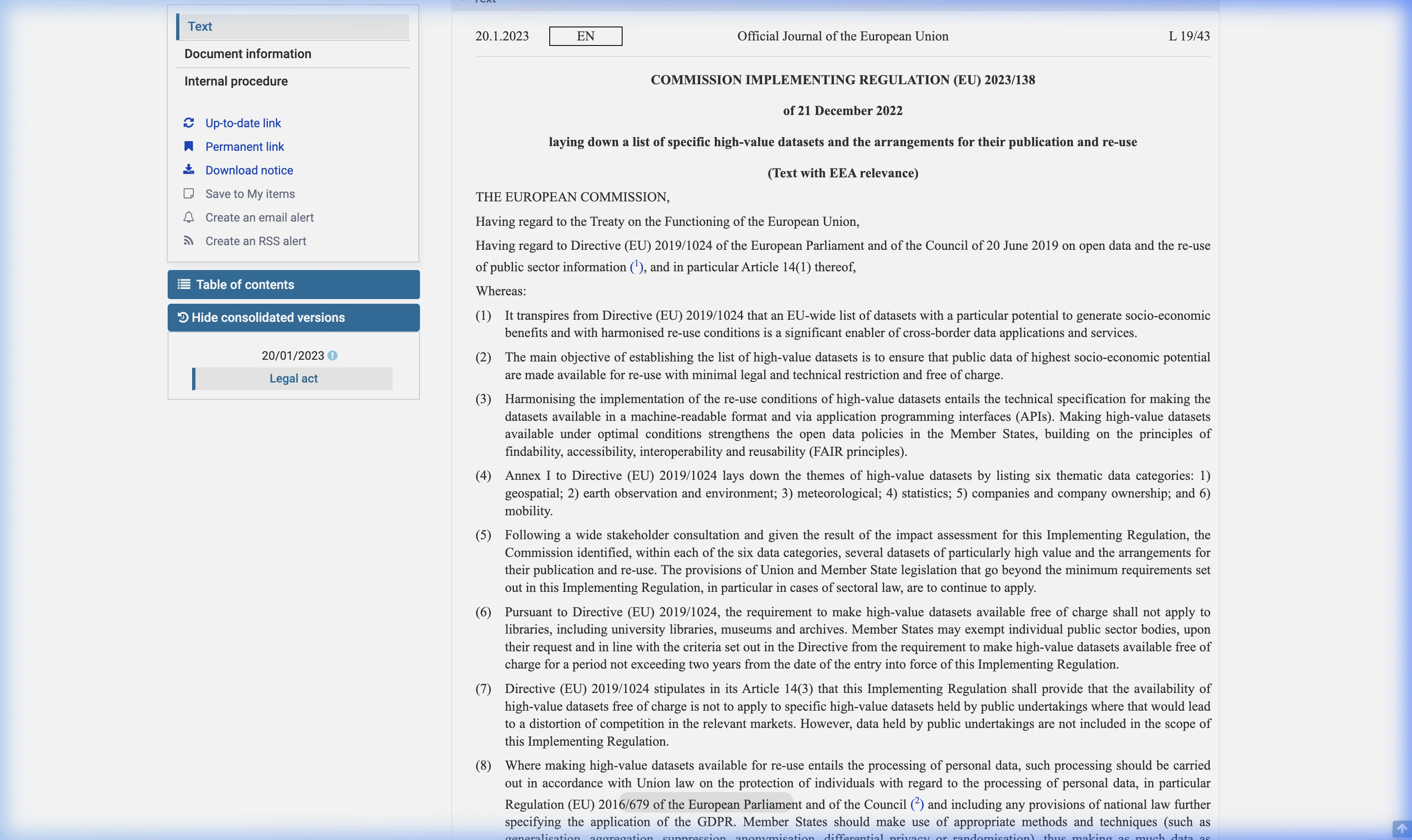
Two legal texts do different jobs. Directive (EU) 2019/1024 sets the wider framework for reusing public-sector information. Implementing Regulation (EU) 2023/138 identifies the high-value datasets and sets more detailed publication conditions. Its requirements applied from 9 June 2024, as the European Commission’s access guide explains.
Which weather data are covered?
Section 3 of the regulation’s Annex identifies five groups: station measurements, validated climate observations, weather warnings, radar measurements and numerical weather prediction output. These are different products. A live thermometer reading and a checked historical series may describe the same station but have different publication schedules and quality status.
The distinction matters when looking for an archive. For validated climate observations, the Annex includes all digitised historical data within the specified scope. A page showing today’s weather does not answer a request for that historical series. Equally, the wording does not promise that every handwritten record has been digitised.
A chart is useful, but access must go further
The meteorological requirements include machine-readable data, public documentation and metadata. The Annex specifies API access and bulk download, with an exception for numerical forecasts, for which it specifies API access. It also sets different update schedules for different products.
Think of two readers studying rainfall at the same station. One wants the newest observation for a dashboard. The other wants years of measurements to investigate how often heavy rain occurs. An API that serves a short recent window may work for the first task. The second reader needs an archive with enough history, together with definitions of the measurement interval and missing values.
This is why a working download button is only the beginning of a dataset check. The practical questions are how far back the records go, which fields are supplied, whether the download can be repeated and where the provider explains revisions. Our European weather-data portal guide compares several access routes.
Free to reuse still means reading the licence
For meteorological high-value datasets, the Annex specifies Creative Commons Attribution 4.0, or an equivalent or less restrictive open licence. Attribution remains relevant when a provider uses CC BY. Calling such data “public domain” would erase that distinction.
The CC BY 4.0 licence summary explains the practical obligations: credit the source, link the licence and indicate changes. For a chart, keep the provider and dataset identifiable in the caption or accompanying methods. If you aggregate hourly observations into daily values, describe that change rather than presenting the result as the provider’s own daily product.
What the rules do not settle
The framework has a defined scope. It is not a promise of unrestricted access to every weather-related document, private company’s database or bespoke analysis service. The Directive includes exclusions, including certain third-party intellectual-property rights and personal-data restrictions.
Nor does common access make observations scientifically interchangeable. Moving a station, changing an instrument or changing a daily reporting boundary can affect comparisons. A permissive licence cannot resolve those measurement questions; they require metadata and an appropriate analysis method.
If you cannot find a dataset, first identify the public body that holds it and the particular series you need. Include the variable, period, station or area, and preferred machine-readable format in your request. The Commission’s access guide explains requests and routes for challenging a refusal. A missing catalogue entry alone is insufficient evidence that an entire national service fails the rules.
Data Annex
Use the legal text to check the dataset group before assessing an access route. This table paraphrases the meteorological publication routes in Annex section 3.2; it does not assess individual providers.
| Dataset group | Access specified in the Annex |
|---|---|
| Weather-station observations | API and bulk download |
| Validated climate observations | API and bulk download |
| Weather warnings | API and bulk download |
| Radar data | API and bulk download |
| Numerical weather prediction | API |
No weather observations were analysed for this explanation. The legal requirements and the practical checks above should be read separately: checking timestamps and station history is part of using data responsibly, not a complete legal compliance test.
Key Technical and Legal Conditions for High-Value Datasets
| Condition area | Regulatory requirement | Operational implication |
|---|---|---|
| Licensing | Creative Commons Attribution 4.0 (CC BY 4.0) or equivalent | Commercial and non-commercial reuse permitted with clear attribution |
| Format | Open, machine-readable formats | Standardized structured data (e.g. CSV, JSON, NetCDF) with open specifications |
| Access mechanisms | APIs and bulk download | Queryable endpoints for automated retrieval alongside complete archive downloads |
| Metadata & documentation | Comprehensive public metadata descriptions | Documented parameter definitions, measurement units, quality codes, and coordinates |
| Historical coverage | All digitized historical series for validated climate data | Full digital period of record must be accessible without artificial date cutoffs |
Data Sources
- Directive (EU) 2019/1024: wider reuse framework, scope and exclusions.
- Implementing Regulation (EU) 2023/138: Articles 3–4 and Annex section 3, covering meteorological datasets and publication arrangements.
- European Commission: open data and high-value datasets access guide: application date, discovery, requests and reuse.
- Creative Commons: CC BY 4.0: attribution and reuse conditions.