How the European Open Data Directive Revolutionized Meteorological Data
A Paradigm Shift in European Climate Science
For decades, the vast archives of historical weather records collected by Europe’s national meteorological services were locked behind paywalls or restrictive licensing agreements. While researchers could sometimes negotiate access, the barriers to entry for independent scientists, students, and the general public were prohibitively high. This fragmentation meant that understanding continent-wide climate patterns required navigating a complex web of national institutions, each with its own pricing model and delivery system.
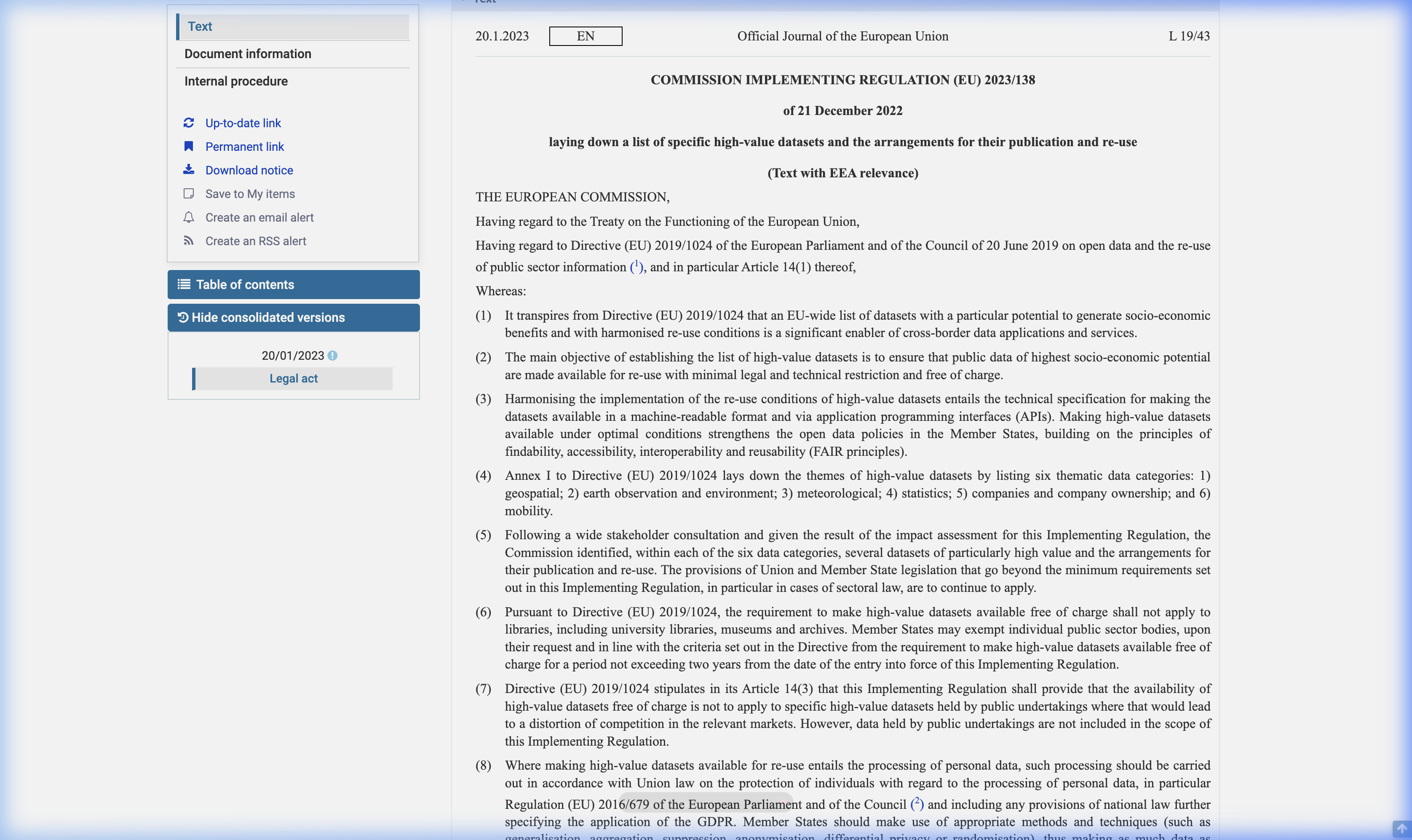
Everything changed with the implementation of the European Open Data Directive (officially Directive (EU) 2019/1024 on open data and the re-use of public sector information), specifically the implementing regulation on High-Value Datasets (HVD) (Regulation (EU) 2023/138). By defining meteorological observations as a category of high-value data, the European Union effectively mandated that public sector weather data must be made available free of charge, under an open license, in machine-readable formats, and via Application Programming Interfaces (APIs).
The directive is explicit in its requirements for meteorological datasets. As outlined in the Annex to the regulation, the high-value meteorological datasets include:
“weather station observations, validated weather data observations, weather warnings, radar data and numerical prediction model (NMP) data.”
By forcing these datasets into the open, the policy intervention catalyzed a profound revolution in accessibility, even though each nation still maintains its own IT infrastructure.
Breaking Down the Paywalls: The National Responses
The directive forced some of Europe’s largest and most prestigious meteorological institutions to rethink their relationship with the public. Here is how three major agencies responded, establishing the foundation for tools like the Climate Explorer.
1. Germany’s Deutscher Wetterdienst (DWD)
Germany’s National Meteorological Service, the Deutscher Wetterdienst (DWD), was an early adopter of the open data philosophy, even preceding the formal enactment of the EU’s High-Value Datasets regulation. However, the directive solidified their commitment.
The DWD OpenData portal is now recognized as one of the most robust and comprehensive meteorological data repositories in the world. It provides unrestrained access to not only standard hourly and daily climatological summaries but also to ultra-high-resolution 10-minute meteorological measurements.
This granular data, covering air temperature, precipitation, wind dynamics, and solar radiation, allows researchers to analyze sudden, intense weather phenomena (like sudden summer squalls) that would be entirely invisible in daily average data. The opening of the DWD archives has spurred a wave of independent research into Germany’s shifting climate patterns and the optimization of its rapidly expanding renewable energy grid.
2. Météo-France
France’s approach to open data required a more significant internal transformation. Historically, Météo-France commercialized substantial portions of its high-resolution historical data. The shift toward compliance with the European Open Data Directive required a completely modernized infrastructure.
Today, the Météo-France Open Data API provides free access to what the agency calls its “Données Climatologiques de Base.” The sheer volume and quality of this newly open archive are staggering. Operating across a territory that spans oceanic, continental, alpine, and Mediterranean climate zones, Météo-France provides an extraordinarily detailed look at European weather.
A standout feature that became available to the public is their 6-minute precipitation data. In an era of increasing flash floods and sudden convective storms, this level of temporal resolution is critical for hydrological risk assessment and urban drainage planning. The data that was once the exclusive domain of state contractors is now available for any researcher or citizen scientist to analyze.
3. Poland’s IMGW-PIB
The Polish Institute of Meteorology and Water Management – National Research Institute (IMGW-PIB) provides a critical lens into the climate of Central and Eastern Europe.
The IMGW-PIB open data portal is a testament to the power of the directive. It exposes decades of quality-controlled observations from over 60 synoptic stations and hundreds of climatological posts. Because Poland sits at the collision point between maritime Atlantic and continental Eurasian air masses, its historical data is vital for tracking continent-wide temperature and precipitation shifts.
Through the power of open data APIs, we can now instantly access hourly wind gust profiles from the Baltic coast, track snow depth accumulation in the Tatra mountains, and model urban heat islands in Warsaw—all utilizing the official, authoritative state records.
The Birth of the WIS 2.0 and E-SOH Standards
The ultimate goal of the Open Data Directive is not just the release of data, but its interoperability. As national meteorological services (NMS) opened their archives, it became clear that a unified standard was needed for near real-time data exchange.
Enter WIS 2.0 (the WMO Information System) and E-SOH (European State of the Environment). These modern, web-architected standards are gradually replacing decades-old, proprietary meteorological communication channels. By standardizing the way data is formatted (often using JSON and MQTT protocols), it becomes possible to aggregate real-time observations from across the continent without writing a separate parser for every single country.
This interoperability is showcased in the EuroMeteo Explorer, which leverages the MeteoGate platform to aggregate these unified WIS 2.0 feeds, providing a live, continent-wide view of Europe’s weather as it happens.
Why This Matters for Climate Resilience
The liberalization of meteorological data under the European Open Data Directive is much more than a technical achievement; it is a critical component of climate adaptation.
- Democratic Access to Science: Independent researchers and journalists can now verify climate trends without relying solely on state-issued summary reports.
- Economic Innovation: Startups and agricultural firms can build hyperspecialized weather risk models utilizing the newly free historical baselines.
- Preparedness: High-resolution historical data allows civic engineers to design infrastructure (like stormwater drains in Paris or wind turbine arrays in the North Sea) that is appropriate for the actual, observed extremes of the localized climate, rather than interpolated guesses.
The European Open Data Directive proved that when high-quality, state-funded meteorological observations are returned to the public domain, the entire scientific and technological ecosystem benefits. As tools like Climate Explorer continue to build bridges to these open APIs, the barrier between global weather archives and the people who need them will continue to disappear.
Frequently Asked Questions (FAQ)
What is the European Open Data Directive?
The European Open Data Directive (Directive (EU) 2019/1024) is a legislative framework that mandates public sector bodies across the European Union to make their data available for re-use. The goal is to stimulate digital innovation, increase transparency, and break down paywalls on public-funded information.
Why are weather and climate datasets considered “High-Value”?
Under the implementing Regulation (EU) 2023/138, meteorological data is explicitly classified as a “High-Value Dataset” because its widespread availability provides massive socio-economic benefits. Free access to this data accelerates climate research, improves agricultural planning, enhances disaster risk management, and fuels the renewable energy sector.
Is historical weather data now completely free in Europe?
Yes, for basic and high-value historical datasets. National meteorological services like Germany’s DWD, France’s Météo-France, and Poland’s IMGW-PIB are now legally required to provide free, machine-readable access to core observation data (including historical archives and real-time feeds) through public APIs.
Do I need special software to access this open meteorological data?
While the raw data is provided via APIs (which typically require programming skills to query and parse), platforms like the Climate Explorer were built specifically to bridge this gap. Climate Explorer connects directly to these official open data portals, allowing anyone with a web browser to visualize and export the data without writing a single line of code.