From Clouds to Code: Europe’s Uneven Shift to Open Meteorological Data
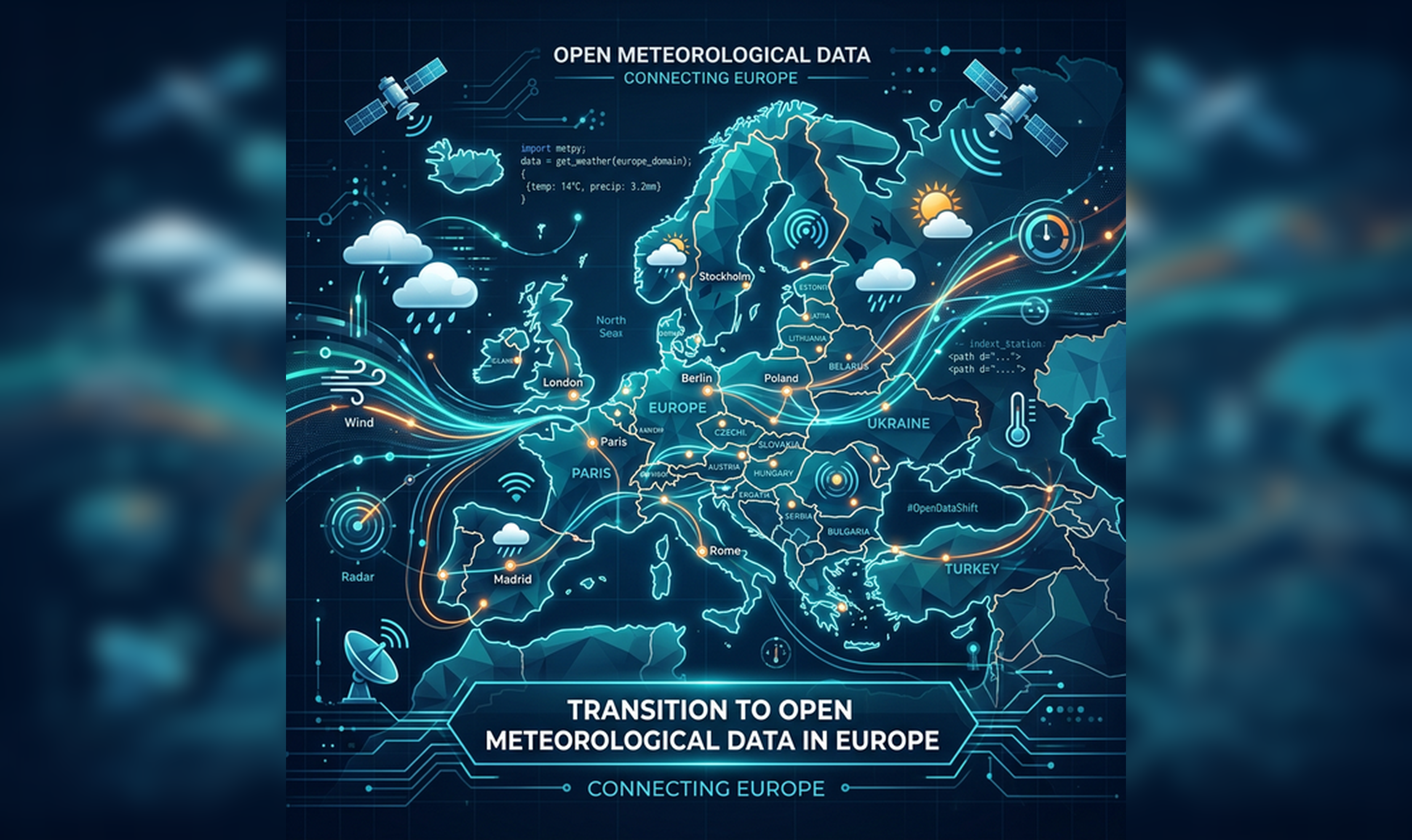
Europe’s open-data framework changed significantly with Directive (EU) 2019/1024, which established the legal basis for High-Value Datasets, and with Implementing Regulation (EU) 2023/138, which specified the dataset categories and the publication requirements.
The HVD regulation requires certain public datasets to be made available free of charge, in machine-readable formats, through APIs, and, where relevant, via bulk download. Meteorological data is one of the six HVD themes and includes weather-station observations, validated climate observations, radar data, weather warnings, and numerical weather prediction data. Those publication and re-use requirements applied from 9 June 2024.
The Reality of Technical Implementation
In practice, however, Europe has not reached a single uniform level of technical implementation. The legal direction is clear, but delivery remains uneven.
Some countries already had mature open-data services and adapted quickly. Others are still modernising their systems, documentation, and APIs. That makes it more accurate to describe the current situation as broad legal alignment with mixed technical maturity, rather than a full, continent-wide compliance.
Country-by-Country: Accessing Meteorological Open Data
A diverse group of European countries already outpace the baseline by providing public access to meteorological observations and related datasets through official portals and APIs. Using tools like the Climate Explorer, linking to these endpoints becomes increasingly important.
These access points are not operationally identical. Some offer anonymous bulk download, some require API keys or registration, and others expose selected datasets or landing pages rather than raw file directories. That variation is part of what makes Europe’s implementation feel uneven in practice.
Official Public Access Points
- Norway: Provides open observation and climate data through the Frost API.
- Netherlands: Provides meteorological datasets through the KNMI Developer Portal, including the EDR API and Open Data API. API keys are required for requests.
- Finland: Provides machine-readable meteorological data free of charge through FMI Open Data.
- Austria: Provides station and spatial datasets through the GeoSphere Austria Data Hub.
- Belgium: Provides open observations and related meteorological datasets through the Royal Meteorological Institute’s open-data portal.
- Denmark: Provides a direct Meteorological Observation API through DMI’s open-data services.
- Hungary: Provides public meteorological archive and open data access, including observation series, through HungaroMet’s data archive and open data tree.
- Poland: Provides public meteorological observation data and API access through IMGW’s public-data service.
- Romania: Provides a public JSON dataset of latest station parameters through the national open-data portal, backed by a Meteoromania endpoint.
- Latvia: Provides access to meteorological and environmental archives through the LVĢMC environmental data archive portal.
- Iceland: Provides public weather-station observation pages through the Icelandic Meteorological Office.
Access Beyond the RODEO Group
Other European nations outside the immediate RODEO group also maintain robust public access points:
- Germany: Provides anonymous bulk download and directory-based open access through the DWD Open Data Server and Climate Data Center.
- Spain: Provides observation and climatological access through AEMET OpenData; API keys are required.
- Ireland: Provides over 2,000 open datasets, including historical measurements, current observations, and forecasts, through Met Éireann’s open-data services.
- Sweden: Provides observation access through the SMHI Open Data Portal and its meteorological observations API.
- France: Provides public API access, including HVD-related observation services, through the Météo-France API portal.
Concrete Examples: From Policy to Code
To make the difference between legal openness and practical access more tangible, here are three real machine-readable entry points:
- Germany (bulk download): DWD climate directory
- Denmark (API): DMI meteorological observations collections endpoint
- Romania (live JSON): Meteoromania station-parameter feed
These examples show the current diversity of implementation: a public file server in Germany, a structured observation API in Denmark, and a national live JSON feed in Romania.
Conclusion
The core takeaway is clear: Europe is moving toward a more open meteorological-data environment, and the HVD regulation has made that transition legally significant.
What needs to be stated more carefully is that implementation is still uneven. While some countries already operate highly mature public observation portals and APIs, others are still building out full technical delivery, often through shared initiatives such as RODEO. Open meteorological data in Europe is real and expanding, but full technical harmonization remains heavily a work in progress.